
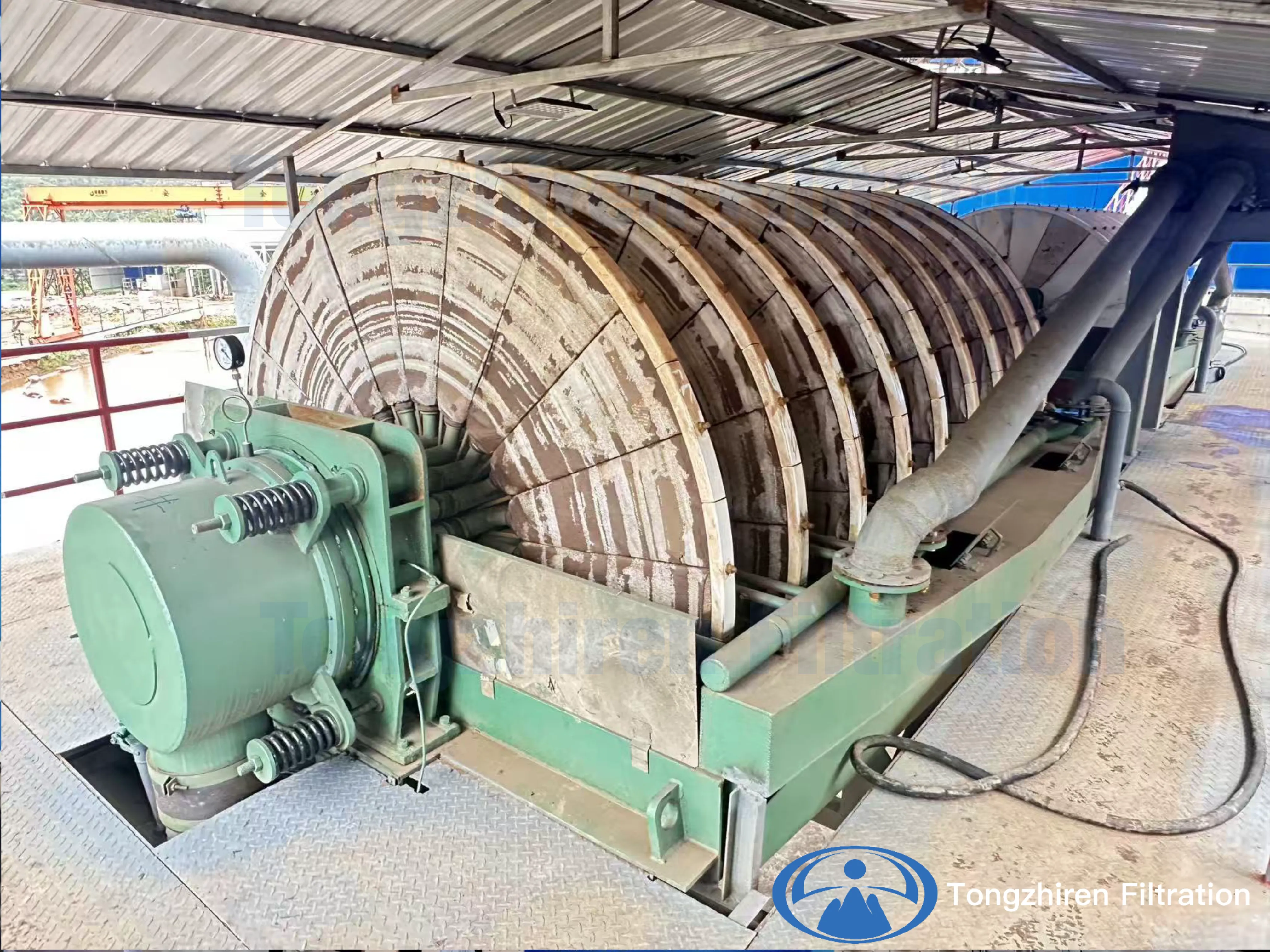
The mining industry is under constant pressure to improve water recovery, reduce operating costs, and maximize production efficiency. Among the many technologies used for concentrate dewatering, the Vacuum Disc Filter (VDF) remains one of the most widely adopted solutions for fine mineral concentrates.
Whether you're upgrading an existing filtration system or designing a new mineral processing plant, choosing the right dewatering equipment is a critical decision. A Vacuum Disc Filter can significantly improve production efficiency, reduce water consumption, and lower operating costs—but only when it is properly matched to your process.
In this first part of our two-part FAQ series, we answer the questions engineers, plant managers, and procurement professionals ask most often before selecting a Vacuum Disc Filter. In Part 2, we cover operation, maintenance, and performance optimization.
A Vacuum Disc Filter is a continuous solid-liquid separation device used primarily for dewatering mineral concentrates. It operates by applying vacuum pressure to rotating filter discs covered with filter cloth. As the discs rotate through a slurry tank, liquid is drawn through the cloth while solids accumulate on the surface, forming a filter cake. The cake is then dried under vacuum and discharged automatically before the cycle repeats.
Its continuous operation makes it particularly suitable for high-capacity beneficiation plants where stable throughput, consistent moisture control, and efficient water recovery are priorities.
Vacuum Disc Filters are widely used across the mining industry and can process many types of mineral concentrates, including:
▪Iron concentrate
▪Copper concentrate
▪Lithium concentrate
▪Lead & zinc concentrates
▪Nickel concentrate
▪Titanium concentrate
▪Coal flotation concentrate
▪Phosphate
▪Graphite
▪Rare earth minerals
▪Feldspar
▪Fluorite
▪Industrial minerals
▪Fine tailings in selected applications
Each application requires different operating parameters, filter media, and equipment configuration to achieve the best filtration performance.
Both technologies have important applications, but they serve different operating requirements.
A Vacuum Disc Filter generally offers:
▪Smaller installation footprint
▪Lower water consumption
▪Higher filtration area per square meter of floor space
▪Continuous automatic operation
▪Lower capital investment for many concentrate applications
▪Excellent suitability for fine mineral concentrates
Horizontal Belt Filters remain advantageous for washing applications or materials requiring long filtration zones, while Vacuum Disc Filters are typically preferred for concentrate dewatering where throughput and operating economy are the primary objectives.
The optimal choice depends on slurry characteristics, particle size distribution, production targets, and downstream process requirements rather than on a single performance metric.
No two mineral processing plants are identical.
Even two iron concentrators may process ore with very different mineralogy, particle size distributions, and production requirements.
Important design considerations include:
▪Ore characteristics
▪Concentrate fineness
▪Production capacity
▪Required cake moisture
▪Available plant space
▪Water recovery targets
▪Automation requirements
▪Local operating environment
A properly engineered filtration solution should be designed around the process—not the other way around. For this reason, equipment customization based on laboratory and production data is often more important than selecting a standard machine.
Providing detailed process information allows manufacturers to recommend the most suitable equipment. Useful information includes:
▪Mineral type
▪Particle size distribution
▪Throughput
▪Slurry concentration
▪Required cake moisture
▪Feed temperature
▪pH
▪Existing plant layout
▪Available utilities
▪Automation requirements
The more complete the process data, the more accurately the filtration system can be designed.
When evaluating filtration equipment, procurement decisions should extend beyond purchase price. Key evaluation criteria include:
▪Filtration capacity
▪Final cake moisture
▪Water recovery efficiency
▪Energy consumption
▪Spare parts availability
▪Maintenance requirements
▪Equipment reliability
▪Automation level
▪Technical support
▪Total lifecycle cost
A lower initial investment does not necessarily translate into lower long-term operating costs. Lifecycle performance is often the most important economic consideration for large mining operations.
Working directly with an Original Equipment Manufacturer (OEM) offers several advantages:
▪Direct communication with engineers
▪Customized equipment design
▪Better quality control
▪Faster technical response
▪Reliable spare parts supply
▪Long-term product support
▪Continuous design improvements based on field experience
An OEM also has a deeper understanding of the interaction between machine design, mineral characteristics, and process requirements, enabling more effective solutions for complex applications.
Selecting the right filtration equipment is not simply a matter of choosing the largest machine or the highest specification sheet. The most successful installations result from matching equipment design with mineral characteristics, production objectives, and long-term operating requirements—and from working with a manufacturer who understands both.
Once the right equipment is in place, the next challenge is running it well. In Part 2: Operation, Maintenance, and Performance Optimization, we answer the most common questions about vacuum levels, cake moisture, filter cloth life, automation, and more.
▪Wills' Mineral Processing Technology, B.A. Wills & J. Finch. Butterworth-Heinemann, 2016.
▪Solid-Liquid Separation. Elsevier, 2000.
▪SME Mineral Processing and Extractive Metallurgy Handbook, 2019.
▪International Mine Water Association — publications on mine water management and water recovery.
▪Metso technical resources on filtration and concentrate dewatering.
▪ANDRITZ technical literature on vacuum filtration systems.
#VacuumDiscFilter #MineralProcessing #Dewatering #SolidLiquidSeparation #Mining #WaterRecovery