
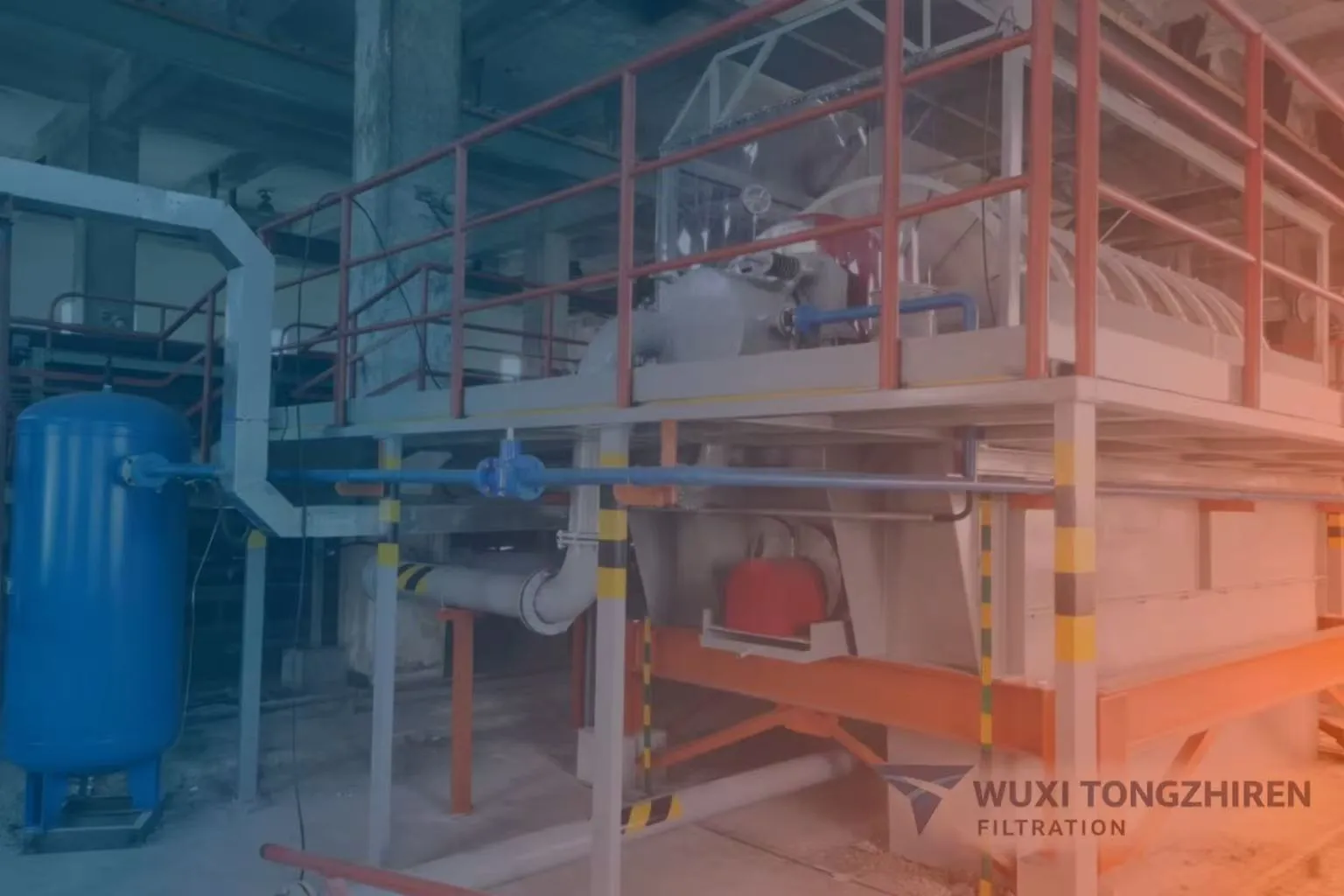
Efficient solid-liquid separation has always been fundamental to the mining industry. As ore grades decline and environmental requirements become more stringent, dewatering technologies have evolved from simple mechanical concepts into highly engineered systems capable of handling enormous processing capacities with remarkable reliability.
Among these technologies, the Vacuum Disc Filter (VDF) has become one of the industry's most established solutions for dewatering fine mineral concentrates. Its evolution reflects over a century of engineering improvements in filtration theory, materials science, mechanical design, and process automation.
This article traces how Vacuum Disc Filters developed from early vacuum filtration concepts into the sophisticated systems used in today's mineral processing plants — and where the technology is heading next.
Vacuum filtration emerged during the late nineteenth and early twentieth centuries as mining and chemical industries sought continuous alternatives to labor-intensive batch filtration.
The underlying principle was straightforward: instead of relying solely on gravity, a pressure differential created by vacuum draws liquid through a porous medium while retaining solid particles on its surface.
Early industrial vacuum filters were relatively simple machines. They offered continuous operation but suffered from several limitations:
▪Low filtration efficiency
▪Limited automation
▪Frequent maintenance
▪Heavy mechanical wear
▪Primitive sealing systems
▪Limited filter media options
Nevertheless, these early designs demonstrated the enormous potential of continuous vacuum filtration for industrial applications.
As production capacities increased, engineers recognized the need for greater filtration area without dramatically increasing equipment footprint.
The rotating disc design addressed this challenge elegantly. Instead of using a single flat filtration surface, multiple vertical discs could be mounted on a common shaft, dramatically increasing effective filtration area while occupying relatively little floor space.
This configuration also allowed several filtration stages to occur simultaneously:
▪Cake formation
▪Cake drying
▪Cake discharge
▪Cloth cleaning
The result was continuous, high-capacity operation suitable for large mineral processing facilities.
One of the most significant advances in Vacuum Disc Filter technology has been the development of filter media.
Early systems often relied on woven natural fabrics that exhibited:
▪High flow resistance
▪Short service life
▪Poor chemical resistance
▪Difficult maintenance
▪Inconsistent filtration performance
Modern synthetic filter cloths offer major improvements, including:
▪Higher permeability
▪Better dimensional stability
▪Improved abrasion resistance
▪Enhanced chemical resistance
▪Longer service life
▪More consistent filtration efficiency
Advances in polymer engineering have also enabled filter media to be tailored to specific particle size distributions and mineral characteristics, improving both throughput and cake quality.
As mining operations expanded, equipment reliability became increasingly important.
Modern Vacuum Disc Filters incorporate numerous engineering improvements compared with early designs, including:
▪Stronger structural components
▪Improved shaft sealing
▪More durable bearings
▪Wear-resistant materials
▪Optimized slurry tanks
▪More efficient filtrate piping
▪Better drive systems
▪Reduced maintenance requirements
These developments have significantly extended equipment service life while lowering lifecycle operating costs.
Early filtration systems often emphasized achieving the highest possible vacuum.
Modern research and industrial experience have shown that filtration performance depends on many interacting variables, including:
▪Particle size distribution
▪Mineralogy
▪Slurry concentration
▪Cake thickness
▪Filtration time
▪Filter cloth permeability
▪Air flow characteristics
▪Equipment geometry
Consequently, contemporary filtration design focuses on process optimization rather than maximizing a single operating parameter. This systems-based approach has become a defining characteristic of modern mineral processing engineering.
Perhaps the most dramatic transformation in recent decades has been the integration of automation.
Earlier Vacuum Disc Filters relied heavily on manual monitoring and operator experience. Today's systems commonly incorporate:
▪PLC control
▪DCS integration
▪Automatic vacuum regulation
▪Liquid level monitoring
▪Motor protection systems
▪Instrumentation
▪Process alarms
▪Data acquisition
▪Remote diagnostics
Automation improves production stability while reducing operator workload and enabling faster response to process changes.
Water scarcity has become one of the mining industry's most significant challenges. As a result, filtration equipment now plays an increasingly important role in sustainable mineral processing.
Modern Vacuum Disc Filters contribute by helping operations:
▪Recover process water
▪Reduce fresh water consumption
▪Improve water recycling
▪Lower energy consumption
▪Minimize waste
▪Improve overall process efficiency
These environmental benefits have become just as important as production capacity in many new mining projects.
Historically, filtration equipment was often supplied in relatively standardized configurations. Today, engineers recognize that no two mineral processing plants are identical.
Modern Vacuum Disc Filters are frequently customized according to:
▪Mineral type
▪Particle size
▪Concentrate fineness
▪Production capacity
▪Required moisture
▪Climate
▪Site conditions
▪Automation requirements
▪Maintenance strategy
This application-specific engineering has become one of the primary reasons for improved filtration performance across diverse mining operations.
The next generation of Vacuum Disc Filters will likely incorporate even greater levels of digitalization. Emerging developments include:
▪Predictive maintenance
▪Artificial intelligence-assisted diagnostics
▪Online performance optimization
▪Digital twins
▪Advanced process analytics
▪Remote monitoring
▪Smart sensor integration
▪Energy optimization algorithms
Rather than functioning as standalone machines, future filtration systems will increasingly become integrated components within intelligent mineral processing plants.
From the earliest vacuum filtration concepts to today's automated mineral dewatering systems, the evolution of Vacuum Disc Filters reflects more than a century of continuous engineering innovation.
Improvements in filtration theory, synthetic materials, mechanical reliability, automation, and process optimization have transformed the technology into a mature industrial standard capable of supporting modern mining operations around the world.
As the industry continues to pursue greater efficiency, improved sustainability, and digital transformation, Vacuum Disc Filters will remain an essential component of mineral processing — continuing to evolve alongside the demands of the next generation of mining.
▪Solid-Liquid Separation. Elsevier, 2000.
▪Wills' Mineral Processing Technology, Barry A. Wills & James Finch. Butterworth-Heinemann, 2016.
▪SME Mineral Processing and Extractive Metallurgy Handbook, 2019.
▪International Mine Water Association — publications on mine water management and water reuse in mining.
▪International Filtration Society — technical resources on filtration science and engineering.
▪Metso — technical publications on industrial filtration and concentrate dewatering.
▪ANDRITZ — engineering literature on vacuum filtration technologies.
#VacuumDiscFilter #MineralProcessing #Dewatering #FiltrationTechnology #Mining #IndustrialEvolution