
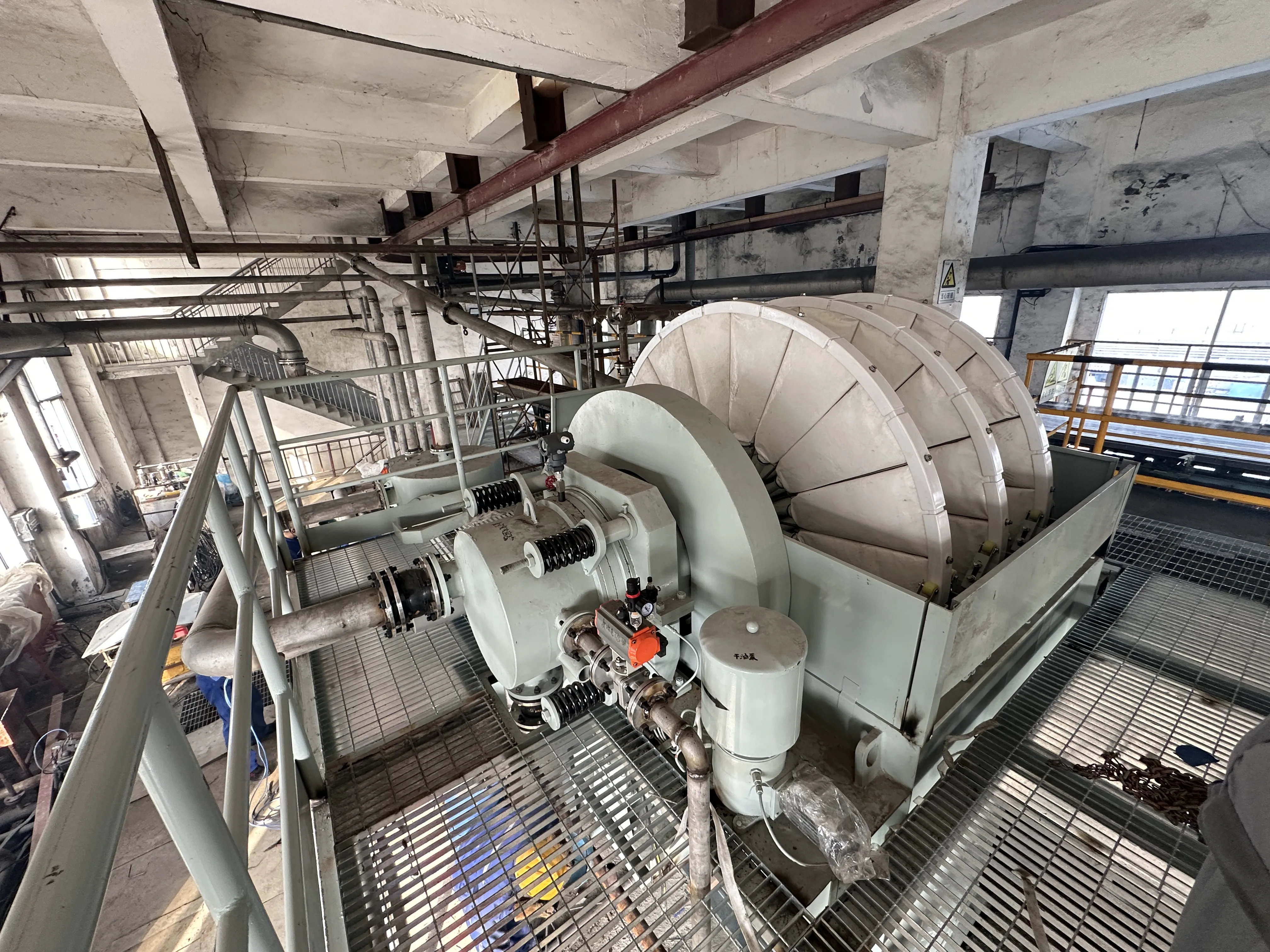
Many mineral-processing plants operate far above sea level. Copper, gold, lithium, and polymetallic mines are commonly found in mountainous regions where atmospheric pressure is substantially lower than it is at the coast. This difference matters when specifying a vacuum disc filter because vacuum filtration depends on the pressure difference between the atmosphere surrounding the filter and the pressure inside its filtrate system.
A machine tested at low elevation cannot automatically be expected to deliver identical capacity and cake moisture at a high-altitude mine. Site pressure, slurry behavior, vacuum-pump selection, air density, cooling, and motor performance should all be evaluated during engineering.
Vacuum is a pressure difference
In a conventional vacuum disc filter, the filter sectors rotate through a slurry trough. A vacuum system lowers the pressure on the filtrate side of the cloth. Atmospheric pressure on the slurry side then helps drive liquid through the cake and filter medium.
The useful driving force is therefore an absolute pressure difference, not merely the number displayed on a relative vacuum gauge.
At sea level, standard atmospheric pressure is approximately 101.3 kPa absolute. Atmospheric pressure decreases as elevation increases. At about 2,000 metres, standard atmospheric pressure is roughly 80 kPa; at about 4,000 metres, it is close to 62 kPa. Actual values vary with weather and local conditions, but the engineering implication is clear: less atmospheric pressure is available to drive filtration.
Why gauge readings can be misleading
A gauge that reports vacuum relative to local atmosphere can make two systems appear similar even when their absolute operating conditions differ. Equipment calculations should use absolute pressure at the site.
Consider a simplified example:
Sea level 71 kPa Atmospheric ~101 kPa abs | High altitude 35 kPa Atmospheric ~65 kPa abs |
This example illustrates a principle, not a performance prediction. The actual filtration result also depends on cake resistance, cloth, slurry concentration, temperature, leakage, and cycle time. Local atmospheric pressure must be included in the design basis.
Possible effects on filtration capacity
Flow through a filter cake is related to the available pressure difference and the resistance of the cake and medium. If the available pressure difference falls while all other conditions remain similar, liquid removal may slow.
Possible plant effects include:
- Lower dry-solids throughput per square metre
- Wetter cake at the original disc speed
- A need for longer cake-forming or drying time
- Thinner cake or less reliable discharge
- Greater sensitivity to air leakage
- Reduced operating margin when the feed becomes finer
The size of the effect cannot be determined from altitude alone. Representative filtration testing and an altitude-adjusted system calculation are required.
Fine material may be more sensitive
Fine particles form small flow passages and a cake with relatively high resistance. When the pressure difference available to overcome that resistance is reduced, the effect can be more noticeable than it is with a freely draining coarse material.
High-altitude projects should pay particular attention to the percentage of ultrafines, clay content, cake compressibility, feed concentration, and required moisture. A small change in particle-size distribution may have a larger operational impact when the filtration system already has limited pressure margin.
Vacuum-pump selection at altitude
The vacuum pump must be selected using local atmospheric pressure and the expected air and vapor load. A pump curve or capacity stated for sea-level conditions should not be applied without correction.
The supplier should evaluate:
- Site elevation and minimum expected barometric pressure
- Required absolute suction pressure
- Air leakage and cake air-flow demand
- Filtrate vapor load and liquid carryover protection
- Seal-water temperature and quality, where applicable
- Ambient temperature
- Motor derating and cooling
- Pipe pressure losses between the filter, receivers, and pump
For liquid-ring vacuum pumps, seal-water temperature is especially important because vapor pressure affects the vacuum the pump can achieve. Warm seal water can reduce performance. The pump supplier should confirm the expected capacity under the actual combination of altitude and water temperature.
Air density affects more than the vacuum pump
At altitude, air is less dense. This can influence motor cooling and the performance of air-cooled equipment. Electrical equipment may require altitude derating or a larger design margin, depending on the motor and applicable standard.
Compressed-air systems used for cake blow-back also need review. The compressor, receiver, piping, valve, and nozzle arrangement must deliver the required pressure and short-duration flow at the filter. Compressor capacity should be checked for site conditions rather than assumed from a sea-level installation.
Do not overlook boiling and cavitation margins
Lower absolute pressure increases the possibility of liquid flashing or boiling, particularly when filtrate or seal water is warm. Filtrate pumps and drain systems require adequate net positive suction head. Receivers, barometric legs, filtrate pumps, and vacuum-pump seals should be arranged with the actual liquid temperature and local pressure in mind.
Unstable liquid removal can cause fluctuating vacuum, receiver flooding, and inconsistent filtration. These problems may look like a filter-control issue even when the underlying cause is hydraulic design.
How to adapt the filter design
Depending on test results and the project requirements, an altitude-adjusted solution may include:
- Additional filtration area
- A revised number of discs or disc diameter
- A different operating speed
- Optimized separation of cake-forming and drying filtrate zones
- Larger or lower-loss vacuum piping
- Improved sealing and leakage control
- Altitude-rated vacuum and filtrate equipment
- Modified cooling or motor selection
- Additional instrumentation for absolute pressure and barometric pressure
Adding a larger vacuum pump is not always the correct answer. The maximum possible driving force is limited by local atmospheric pressure, and excessive air flow can increase energy consumption without resolving cake resistance or air bypass.
Information to include in a high-altitude inquiry
Provide the equipment manufacturer with:
- Site elevation and available barometric-pressure data
- Minimum and maximum ambient temperature
- Slurry and wash-water temperature
- Material type and particle-size distribution
- Feed solids concentration and slurry density
- Dry-solids throughput
- Target cake moisture and filtrate quality
- Available seal water and compressed air
- Electrical supply and applicable motor standard
- Laboratory or pilot filtration results
If test work is performed near sea level, the test report should record absolute pressure so the results can be interpreted for the installation site.
Design for the mine, not the factory floor
High-altitude filtration is not a separate technology, but it does require a correct design basis. Using absolute pressure, representative test work, properly corrected pump data, and site-rated auxiliary equipment helps avoid unpleasant capacity surprises after commissioning.
Tongzhiren Filtration designs vacuum disc filter systems for mineral concentrate, tailings, and industrial slurry applications. Send us your site elevation, slurry data, required throughput, and target cake moisture so our engineers can evaluate the duty under local conditions.
Contact us
Email Info@tzrfiltration.com WhatsApp +86 139 1246 6955
| Info@tzrfiltration.com | |
| +86 139 1246 6955 |