
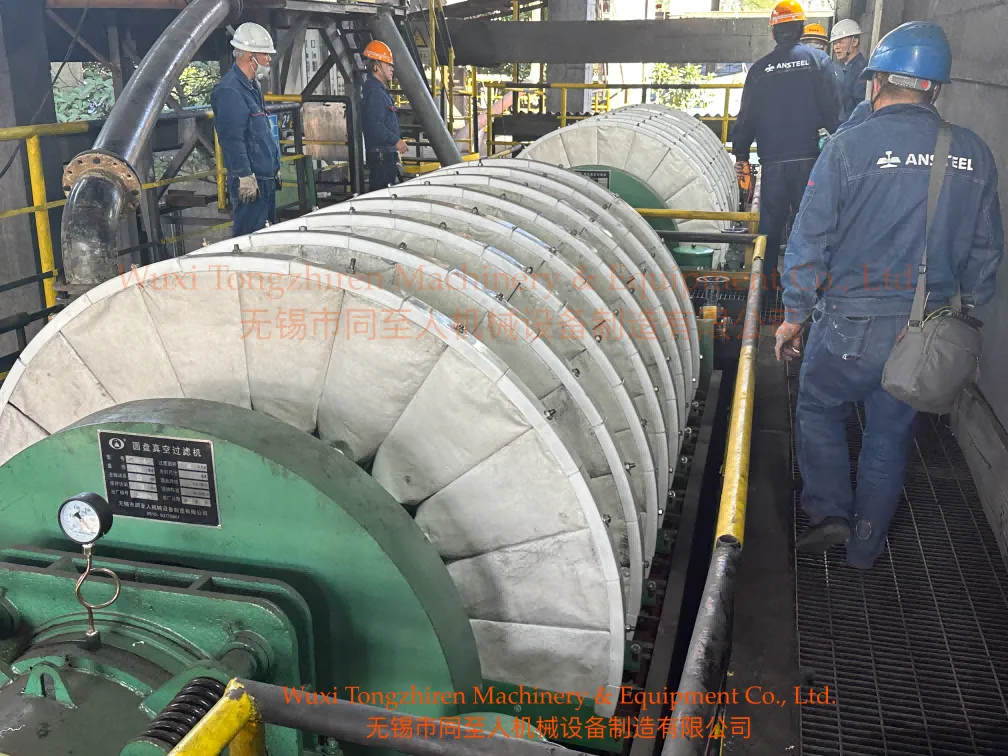
Mineral-processing plants can choose from several technologies for concentrate and tailings dewatering. Three common options are conventional vacuum disc filters, ceramic disc filters, and filter presses. All separate liquid from solids, but they use different mechanisms and create different trade-offs in capacity, moisture, energy, maintenance, footprint, and process flexibility.
There is no universal winner. The correct technology depends on the slurry, the required cake, and the way the equipment must fit into the overall flowsheet.
| Factor | Conventional vacuum disc filter | Ceramic disc filter | Filter press |
|---|---|---|---|
| Operating mode | Continuous | Continuous | Batch / cyclic |
| Main driving force | Vacuum through filter cloth | Capillary action and vacuum through microporous ceramic sectors | Hydraulic feed pressure; some designs add membrane squeezing and air drying |
| Typical strength | High continuous capacity in a compact footprint | Low air flow through saturated ceramic media and efficient concentrate dewatering | High pressure and potentially low final moisture |
| Filter medium | Replaceable cloth bags or covers | Rigid microporous ceramic sectors | Replaceable cloths on plates |
| Cake discharge | Blow-back or scraper arrangement | Scrapers leave a thin protective residual layer | Plates open and cake drops or is assisted out |
| Main operational consideration | Vacuum system, cloth condition, and continuous discharge | Ceramic regeneration, scraper adjustment, and feed consistency | Cycle time, plate/cloth condition, cake release, and batch auxiliaries |
This table is a starting point. Actual results must be established through test work.
A series of cloth-covered sectors rotates through a slurry trough. Vacuum draws filtrate through the cloth while solids form a cake. The cake continues to dewater after leaving the trough and is then discharged before the sector returns to the slurry.
The technology offers continuous operation and a large filtration area relative to floor space. Disc diameter, number of discs, speed, trough arrangement, cloth, and vacuum system can be configured for the duty.
Its performance depends strongly on cake permeability and the pressure difference available under vacuum. Very fine or highly resistant cake may require substantial filter area or may favor a pressure-filtration test.
A ceramic filter uses rigid microporous sectors. When the sectors are immersed, capillary action and vacuum draw liquid through the pores while solids remain on the surface. Because the wetted pores restrict air penetration, ceramic filtration can use much less process air than a conventional cloth-covered vacuum filter in suitable applications.
Cake is normally removed with scrapers. A thin residual layer is left on the sector to protect the ceramic surface. The sectors require continuous backwashing and periodic regeneration to prevent pore blockage and restore permeability.
Ceramic filters are not automatically suitable for every slurry. Sticky, oily, scaling, or highly variable feeds require careful evaluation of regeneration chemistry, pore fouling, sector cost, and scraper control.
A filter press fills chambers between plates with slurry under pressure. Solids accumulate on the cloth and liquid passes through the plates to the filtrate system. Depending on the design, the cake may then be compressed by membranes, washed, and dried with air. At the end of the cycle, the press opens and discharges the cake.
Unlike a disc filter, a filter press operates in cycles. Its effective capacity depends on the complete cycle: closing, filling, filtration, optional squeezing or drying, opening, cake discharge, cloth washing, and preparation for the next batch.
Filter presses can produce a drier cake in many duties, but they also require high-pressure feed equipment, plate-shifting systems, cake-discharge space, and careful cycle coordination. Large plants may need multiple units to provide the desired availability and continuous upstream operation.
A technology comparison should be made at an agreed dry-solids throughput and feed condition. Important measures include:
Lower cake moisture does not always mean lower total cost. A filter producing cake one percentage point drier may still cost more per tonne if it requires more units, longer cycles, expensive media, or substantial auxiliary equipment. Conversely, lower moisture can create major savings in transport or thermal drying. The economic value depends on what happens after filtration.
Particle-size distribution, mineralogy, feed solids, temperature, pH, residual reagents, and clay content affect every filtration technology. However, the technologies may respond differently to variability.
A continuous disc filter can respond quickly to changes in feed density and cake formation. A press may allow operators to adjust filling, squeezing, and drying stages for a difficult batch, but changes also affect cycle capacity. Ceramic media may provide efficient operation with consistent feed yet require extra attention when scaling or pore-blocking contaminants change.
Test the equipment with average and difficult slurry samples, not only the easiest material available.
Disc filters concentrate a large area into a relatively small floor footprint, but space is still needed for the trough, drive, vacuum receivers, pumps, piping, cloth change, and cake chutes.
A filter press needs floor area plus vertical and horizontal clearance for plate movement, cloth service, cake discharge, and structural support. It may also require surge tanks to separate continuous upstream production from cyclic filtration.
Compare complete layouts, including access platforms and auxiliaries, rather than the filter body alone.
Laboratory testing should determine cake formation, filtration rate, achievable moisture, filtrate quality, media behavior, cake release, and sensitivity to cycle variables. When two technologies remain viable, comparative pilot testing can provide a stronger basis for capital and operating-cost estimates.
Request that suppliers state:
A conventional vacuum disc filter is often attractive for continuous, high-capacity dewatering in a compact area. A ceramic filter may reduce vacuum-system air demand and provide efficient dewatering for suitable, consistent concentrates. A filter press may be preferred when high pressure and very low cake moisture justify cyclic operation and additional auxiliaries.
Tongzhiren Filtration manufactures conventional and ceramic vacuum disc filters and works with mineral-processing customers to evaluate dewatering duties. Share your slurry data, throughput, moisture target, utilities, and layout constraints with our engineering team.
| Info@tzrfiltration.com | |
| +86 139 1246 6955 |