
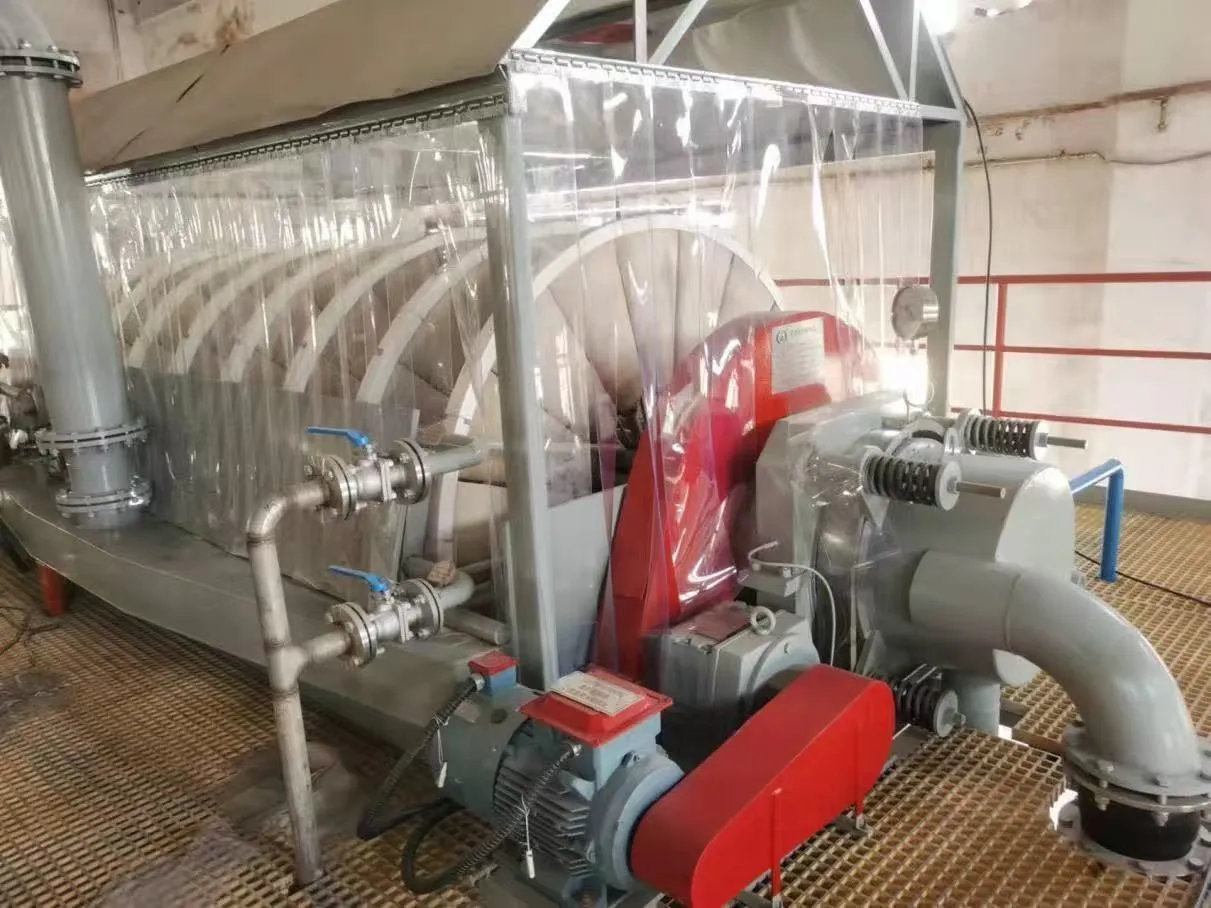
A vacuum disc filter can only perform consistently when its feed is consistent. In many mineral-processing plants, the filter receives concentrate or tailings from a thickener. If the thickener underflow density rises and falls, the filter may alternate between thin, weak cake and overloaded, difficult-to-handle slurry—even when the filter itself is in good mechanical condition.
For this reason, filtration performance should be evaluated as part of a thickening-and-filtration circuit rather than as an isolated machine. Stable underflow density, controlled flow, suitable rheology, and a well-designed surge system can improve capacity, cake moisture, filtrate quality, and operator control.
Quick answer
Stable thickener underflow helps a vacuum disc filter form a uniform cake at a repeatable rate. Feed that is too dilute can reduce cake thickness and dry-solids capacity, while feed that is too dense can become difficult to pump and distribute. The best result comes from controlling underflow solids, flow, rheology, surge-tank level, and filter settings as one dewatering circuit.
A thickener removes a large volume of water by gravity settling. Solids settle into a bed, are moved by rakes, and leave as concentrated underflow. Clarified overflow normally returns to the process-water circuit.
A vacuum disc filter performs the next stage of dewatering. Vacuum draws liquid through filter media, forms a cake, removes additional moisture, and discharges the cake continuously.
Sending unnecessarily dilute slurry to the filter makes the filter remove water that the thickener could often remove more economically. At the same time, forcing the thickener to produce underflow that is too dense or too viscous can create pumping, mixing, and feed-distribution problems. The target is not maximum thickener density at any cost; it is a stable feed condition that the complete circuit can handle.
Dilute feed contains less dry solids in each cubic metre of slurry. The filter sectors may not build enough cake during the submerged part of the cycle. The result can include:
Thin or incomplete cake
Poor cake release during blow-back
Cracking and preferential air flow
Reduced dry-solids throughput
Unnecessary hydraulic loading on the filtrate system
Unstable filtrate clarity during initial cake formation
Higher process-water circulation through the filter
Operators sometimes try to compensate by slowing the disc. That may give the cake more time to form, but it also reduces the number of cycles per hour. If the true cause is low thickener underflow density, repeated filter-speed adjustment treats the symptom rather than the upstream problem.
Very dense underflow may have high viscosity or yield stress. It can become difficult to pump, distribute, and keep uniform in the filter trough. Possible effects include:
Variable flow from the underflow pump
Plugging or buildup in pipelines
Poor mixing in a surge tank
Uneven solids distribution across the filter trough
High load on pumps and agitators
Rapid settling if flow stops
Difficult restart after a shutdown
The relationship between solids concentration and rheology is not linear. A small increase in solids can produce a large increase in yield stress for some materials, especially fine or clay-rich slurry. Density and flow therefore need to be considered together with pumpability and agitation.
Suppose one thickener produces an average underflow of 55% solids, but the actual value repeatedly swings between 48% and 60%. Another produces a stable 53%. The second condition may support better filtration because operators can establish a consistent disc speed, trough level, vacuum loading, and cake-discharge setting.
Large swings force the filter to chase the process. A setting suitable for dense feed may create thin cake when the next dilute batch arrives. Stable feed allows optimization around a repeatable condition and provides clearer evidence when the filter itself needs attention.
Metso has reported a concentrate-thickener application where varying underflow density directly influenced downstream filtration and lower feed density reduced filtration efficiency. The lesson is broadly applicable: upstream control quality affects the apparent performance of downstream equipment.
Underflow solids concentration. Measure density using a reliable online instrument and verify it with regular laboratory samples. Density instruments can drift or be affected by air entrainment, scale, and changing slurry properties. Use one agreed calculation basis—such as percentage solids by weight—so operations, laboratory, and equipment suppliers compare the same number.
Solids inventory or bed pressure. Underflow density is influenced by the amount of solids retained in the thickener and the residence time available for compaction. Operating with too little inventory can cause dilute underflow. Excessive inventory can increase rake torque, risk bogging, and restrict the thickener’s ability to handle disturbances.
Rake torque. Rake torque provides an important constraint. A control strategy should not pursue density while allowing torque to approach an unsafe level. Trend torque together with bed pressure, underflow density, and pumping rate.
Overflow clarity. Cloudy overflow indicates valuable solids or fine material leaving the thickener. This affects recovery and the quality of water returned to the plant. Underflow density and overflow clarity should be optimized together rather than treating one as the only objective.
Flocculant preparation and dosage. Poor dilution, incomplete maturation, incorrect dosing, or an unsuitable flocculant can reduce settling performance and create unstable underflow. Excessive dosage can also change underflow rheology and raise operating cost. Test the actual slurry instead of relying on a fixed historical dose when ore conditions change.
A correctly sized and agitated tank between the thickener and filter can decouple short-term variations. Its job is to provide:
Adequate residence time to smooth flow changes
Continuous feed while the thickener pump changes speed
Uniform solids distribution
A stable suction condition for the filter-feed pump
Safe handling during brief filter interruptions
The tank should not become a settling vessel. Agitation must keep solids suspended without introducing excessive air or degrading floc structure in a way that harms filtration. Tank level, mixer selection, overflow routing, and minimum operating volume should be included in the circuit design.
Independent control loops can fight one another. For example, a thickener controller may change underflow-pump speed to manage solids inventory while a downstream tank controller changes demand to maintain level. Poor tuning can create repeated flow and density cycles.
A coordinated strategy may use:
Thickener solids-inventory control within safe torque limits
Density feedback to adjust the inventory target
Filter-feed tank level to manage short-term flow balance
Filter throughput demand as a bounded input rather than an unrestricted command
Alarms for density, torque, tank level, and loss of agitation
Trend displays that place thickener and filter variables on the same timeline
The exact strategy depends on the plant and should be developed with process-control specialists.
When filter capacity or cake moisture changes, collect time-aligned data for:
Thickener feed rate and density
Flocculant dose
Bed pressure or solids inventory
Rake torque
Underflow density and pump speed
Filter-feed tank level
Filter feed flow and density
Disc speed and trough level
Absolute vacuum
Cake moisture and dry-solids throughput
Time alignment matters because the slurry sampled at the thickener does not reach the filter immediately. Account for tank residence time and pipeline transport delay before concluding that two measurements are related.
Bench or pilot filtration testing at several feed densities can identify the practical window for cake formation, throughput, moisture, and discharge. Rheology and pumping tests may be required at the upper end of the density range.
The operating window should define:
Preferred underflow-solids range
Short-term alarm limits
Acceptable feed-flow variation
Maximum rheology or pumping constraint
Filter settings for normal conditions
Response when feed leaves the approved range
This creates a shared target for thickener and filter operators.
A stable filter begins with stable feed. Thickener inventory control, flocculation, underflow pumping, surge capacity, agitation, and filter settings all influence the final result. Improving only the filter may produce limited benefits if underflow density continues to cycle.
Tongzhiren Filtration manufactures mining thickeners and vacuum disc filters for integrated mineral dewatering circuits. Send our engineering team your thickener underflow data, particle-size distribution, required dry-solids capacity, and target cake moisture so we can review the complete duty.
| Info@tzrfiltration.com | |
| +86 139 1246 6955 |
What thickener underflow density is best for a vacuum disc filter?
There is no universal percentage. The preferred range depends on particle size, mineralogy, rheology, cake-forming rate, and pumpability. Laboratory or pilot filtration tests at several feed densities should establish the operating window for the specific slurry.
Does higher thickener underflow density always improve filtration?
No. Higher density reduces the amount of water sent to the filter, but excessive density can sharply increase viscosity or yield stress. This may cause unstable pumping, poor trough distribution, and difficult restart conditions.
Why does dilute feed reduce vacuum disc filter capacity?
Dilute feed contains less solid per unit volume, so a filter sector may form only a thin cake during immersion. Thin cake can reduce dry-solids throughput, discharge poorly, and allow uneven air flow during drying.
Should thickener and filter controls be coordinated?
Yes. Thickener inventory, underflow pumping, surge-tank level, filter-feed flow, and filter speed interact. Coordinated control and time-aligned trends reduce cycling and make performance problems easier to diagnose.