
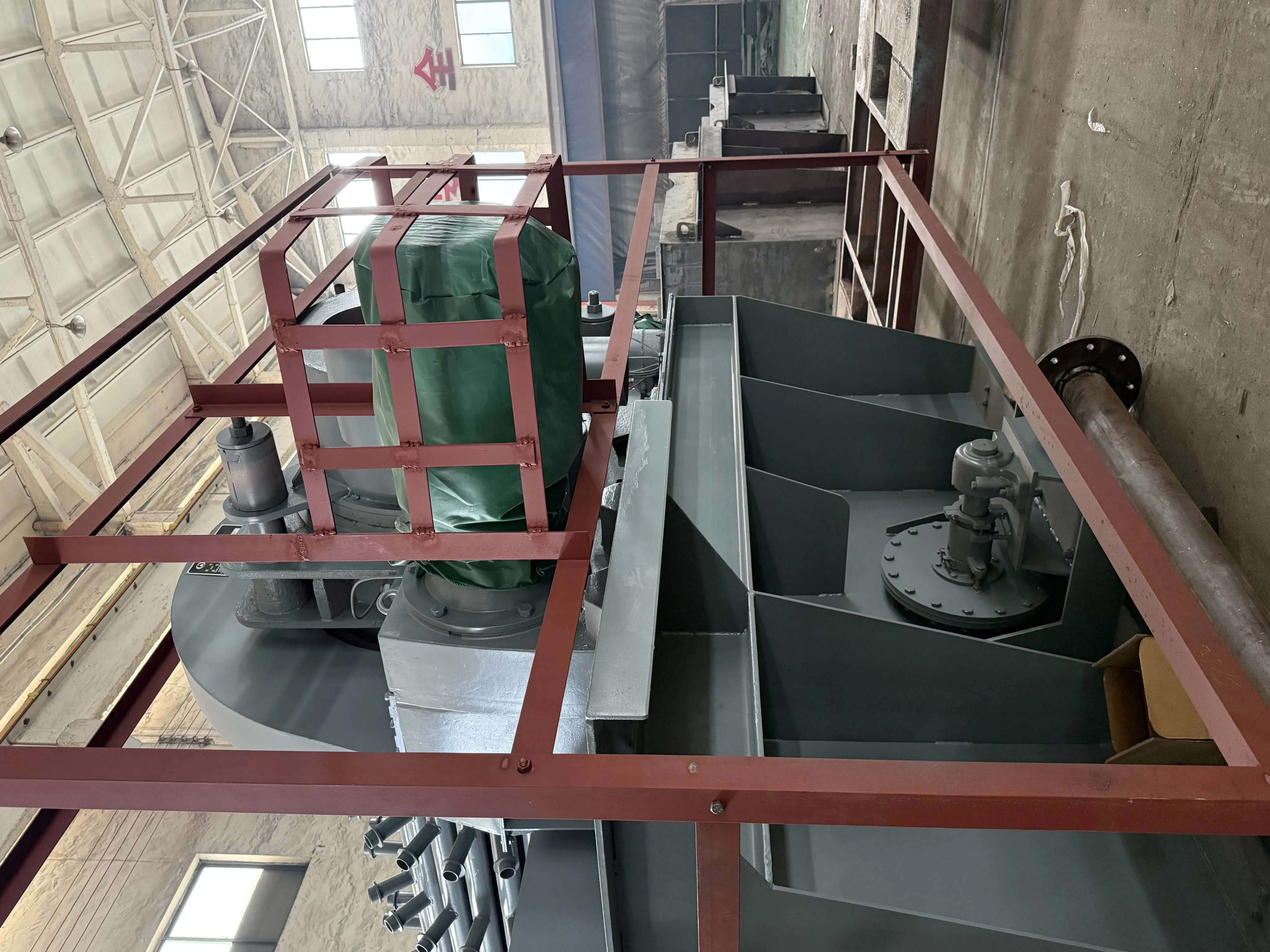
Fine iron ore concentrate must be dewatered before pelletizing, storage, rail transport, or blending. Filtration performance affects the amount of water entering the pellet plant, the consistency of downstream mixing, energy use, material handling, and the plant water balance.
Vacuum disc filters are widely associated with high-capacity iron ore concentrate duties because they provide a large filtration area in a compact footprint and operate continuously. Their performance depends on ore type, particle fineness, feed density, cake permeability, cloth condition, vacuum-system capacity, and the required final moisture.
Quick answer
A vacuum disc filter dewaters iron ore pellet feed by forming concentrate cake on cloth-covered rotating sectors under vacuum. Liquid passes through the cloth into the filtrate system, while the cake is dried by air flow and discharged continuously. Successful operation requires representative testwork, stable thickener underflow, correctly selected cloth, controlled disc speed and submergence, sufficient vacuum at site conditions, and a cake-moisture target coordinated with pelletizing requirements.
After grinding and beneficiation, iron ore concentrate is commonly thickened to remove bulk water. The underflow then enters the filtration plant. Filter cake may be conveyed directly to a pelletizing plant, stockpiled, blended, or transported to another site.
The filtration plant usually includes:
These components must be designed as one production system. Increasing filter area cannot correct an undersized filtrate pump or unstable feed tank.
Pelletizing normally requires controlled addition of water, binders, fluxes, and other materials before green balls are formed. Excess filter-cake moisture can reduce the plant's ability to control the final mix, overload conveyors, create sticky buildup, and increase thermal demand. Cake that is unnecessarily dry may consume extra filtration energy or reduce throughput without improving pellet quality.
The correct moisture target depends on:
Specify an acceptable range and variability, not only an average value.
Pellet feed is finely ground. As the fraction of ultrafines increases, cake pores become smaller and resistance to liquid and air flow generally rises. Report the complete particle-size distribution, including the finest fraction.
Magnetite and hematite concentrates can filter differently. Goethite, hydrated minerals, clays, and altered gangue may retain more water or create less-permeable cake.
Two samples with similar size distributions can behave differently because particle shape, porosity, and surface characteristics change the amount and form of retained water.
Stable, suitably dense thickener underflow supports uniform cake formation. Dilute feed may create thin cake and low dry-solids capacity. Excessively dense or high-yield-stress feed may become difficult to pump and distribute.
Flocculant carryover, pH, dissolved ions, temperature, and process-water recycling can change settling, cake structure, cloth blinding, and filtrate quality.
Each disc contains multiple sectors connected to a control head. During rotation:
The control head separates cake-forming, drying, and discharge zones. Seal condition and zone timing directly affect vacuum efficiency, filtrate routing, and cake release.
Start with the maximum continuous dry-solids duty rather than annual wet tonnes. Representative testwork should determine the specific dry-solids capacity at the required moisture and filtrate clarity.
Required effective area = design dry-solids throughput ÷ design-specific filtration capacity
The design-specific capacity should include a documented allowance for ore variation, cloth aging, and stable plant operation. Installed area must also reflect availability requirements and the consequence of taking one filter offline.
The final selection considers disc diameter, number of discs, effective area, drive arrangement, trough design, sector type, and the capacity of every auxiliary system.
A useful filtration program tests more than one ideal sample. Include:
Pilot testing may be justified when laboratory scale cannot reproduce feed distribution, long-term cloth blinding, or the required operating window.
Trend thickener density, bed inventory, rake torque, flocculant dose, underflow-pump speed, filter-feed tank level, and filter results on the same timeline. This helps separate upstream disturbances from filter defects.
Slower rotation increases cake-forming and drying time but reduces cycles per hour. Faster rotation may produce thin cake with poor discharge. Change one major variable at a time and allow the circuit to stabilize.
Stable level provides repeatable submergence and cake-forming time. Verify the level instrument against physical observations and maintain the overflow or control valve.
Measure absolute pressure near the filter and receivers. Air leakage, high altitude, liquid carryover, undersized piping, or worn control-head seals can reduce usable pressure differential.
Blinded cloth raises resistance and moisture. Verify wash-water pressure, nozzle pattern, water quality, spray timing, and drainage. Excessive washing can waste water and dilute the circuit, so use a performance-based frequency.
Review feed and filter data together. If every filter changes at the same time, investigate the shared feed or utility system before assuming simultaneous mechanical failure.
Recovered filtrate can reduce freshwater demand, but suspended fines should be monitored. Continuous cloudy filtrate may indicate torn cloth, loose seams, sector damage, control-head leakage, or incorrect valve routing.
Fine iron solids returned with filtrate can create circulating loads, increase thickener demand, block nozzles, and reduce water quality. Use turbidity or suspended-solids trends, periodic laboratory analysis, and inspection of individual filter branches.
Conventional vacuum disc filters use cloth-covered sectors and vacuum pumps to create the pressure differential. Ceramic disc filters use microporous sectors and capillary action; Metso reports their use in iron ore pelletizing-feed applications with reduced vacuum-pump demand. Ceramic systems also require backwashing and periodic chemical or ultrasonic regeneration.
Neither technology is universally best. Compare tested moisture, throughput, filtrate clarity, energy use, media life, cleaning requirements, capital cost, and maintenance capability at the specific site.
Tongzhiren Filtration manufactures vacuum disc filter systems for iron ore concentrate, tailings, and mineral slurries. Send the following for a technical review:
| Info@tzrfiltration.com | |
| +86 139 1246 6955 |
Why is iron ore pellet feed difficult to dewater?
Pellet feed is finely ground and may contain ultrafines, clays, goethite, or porous particles that create high cake resistance and retain water.
What controls vacuum disc filter capacity for iron ore concentrate?
Capacity depends on effective area, feed density, particle size, mineralogy, cloth, cake resistance, vacuum, disc speed, submergence, moisture target, and discharge reliability.
Does slower disc speed always reduce moisture?
It increases formation and drying time, but it also reduces cycles per hour and may build excessively thick cake. Optimize throughput, moisture, clarity, and discharge together.
How can pellet-feed moisture variation be reduced?
Stabilize thickener underflow and trough level, maintain cloth and vacuum systems, use representative sampling, and control settings within a tested operating window.
When should ceramic filtration be considered?
Consider it when representative testing shows that microporous ceramic sectors can meet the required moisture, throughput, clarity, energy, and maintenance objectives for the concentrate.