
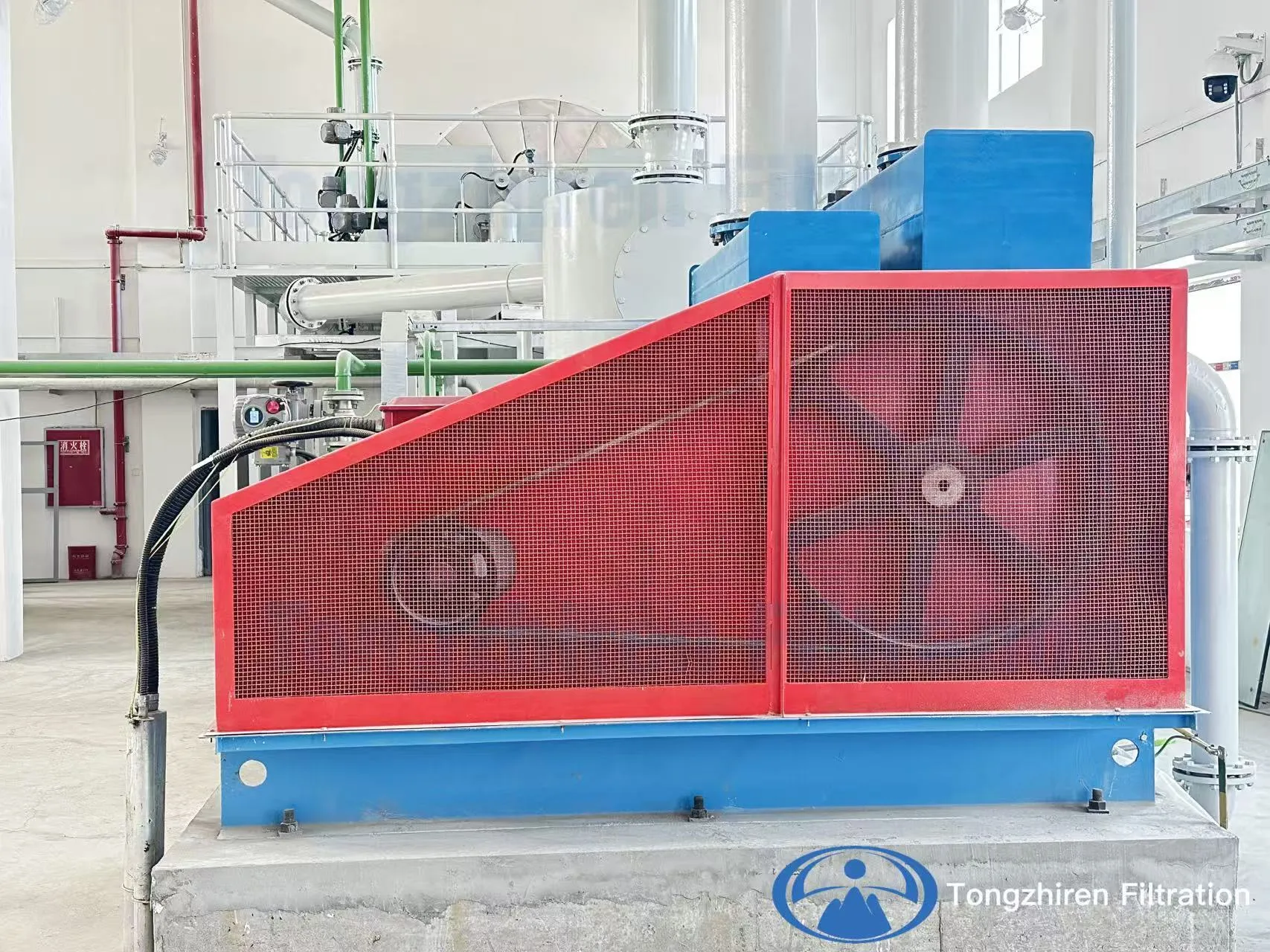
Lead and zinc flotation concentrates must be dewatered before storage, blending, transport, or delivery to a smelter. A well-selected vacuum disc filter can provide continuous filtration, high filtration area in a compact footprint, recover process water, and reduce valuable solids losses. The correct filter area and operating settings must be established from representative slurry testwork because lead and zinc concentrates can behave very differently even within the same plant.
How are lead and zinc concentrates dewatered? After flotation, each concentrate is normally thickened and then filtered. In a vacuum disc filter, the discs rotate through the slurry while vacuum draws liquid through the filter cloth. Solids form a cake on the cloth, the cake continues to dewater above the slurry level, and compressed-air blowback helps discharge it. The filtrate returns to the water circuit or receives further treatment.
Vacuum disc filtration is a strong candidate when the concentrate forms a stable, permeable cake and the required final moisture can be reached under vacuum. Pressure filtration or another technology may be more suitable when the product is exceptionally fine, compressible, sticky, or subject to a very low moisture specification.
Lead-zinc ore is commonly processed through flotation circuits that produce separate lead-rich and zinc-rich products. Although both streams may come from the same orebody, their filtration behavior can differ because their mineral composition, grind size, reagent exposure, and fine-particle content are not identical.
Galena-rich lead concentrate may form a dense cake, while sphalerite-rich zinc concentrate can show a different resistance to liquid flow. Pyrite, silicates, oxidation products, and entrained slimes may further change cake permeability. Variability can also appear when the mine blend or grinding target changes.
For that reason, the plant should define a filtration envelope for each concentrate rather than relying on a single laboratory result.
A typical concentrate dewatering line follows this sequence:
Stable thickener underflow is important. If feed density repeatedly rises and falls, cake thickness, moisture, filtrate clarity, and discharge behavior can vary from one disc revolution to the next. The feed tank should keep solids suspended without introducing unnecessary air or destroying floc structure.
Higher feed density often supports faster cake formation and reduces the water load handled by the filter. However, excessive viscosity or unstable thickener underflow can limit mixing and distribution. The best density is the range that produces a uniform cake while remaining pumpable and well mixed.
Coarser particles create drainage pathways. Ultrafines fill those pathways and increase capillary resistance. A modest change in the fraction of very fine particles can reduce filtration rate and raise cake moisture even when the nominal grind size appears unchanged.
Oxidized minerals, clays, and flotation reagents affect how water interacts with particle surfaces. Reagent changes made to improve flotation can therefore influence the downstream filter. When filtration changes suddenly, review both the filter conditions and recent upstream chemistry.
A thicker cake may increase dry-solids production per revolution, but it also needs more time to dewater and can discharge poorly. A thinner cake can leave the filter drier but may lower throughput. Disc speed and slurry level should be optimized together.
Vacuum provides the driving force that moves liquid through the cake and cloth. Air leakage, blocked filtrate paths, worn valve components, high site altitude, or an undersized vacuum system can reduce the effective pressure differential at the filter.
The basic sizing relationship is:
Required filtration area (m²) = Dry solids feed rate (kg/h) ÷ Tested specific throughput (kg/m²·h)
The tested throughput must be tied to the required cake moisture and filtrate quality. A result is not useful if it delivers high throughput but produces cake that cannot be handled or filtrate with unacceptable solids.
Testwork should cover:
A design allowance should reflect real variability, planned production growth, cloth aging, maintenance intervals, and seasonal temperature changes. It should not be an unexplained percentage added to weak test data.
Cloudy filtrate is not merely a housekeeping issue. Fine lead- or zinc-bearing particles that pass through the cloth can lower saleable recovery, circulate through the water system, and alter upstream flotation chemistry.
If filtrate clarity deteriorates, check for torn or incorrectly fitted cloth, damaged sector seals, excessive blowback, poor cake formation, feed dilution, and ultrafine surges. Measure suspended solids rather than relying only on visual appearance. A mass balance can convert filtrate solids into metal loss per day, making the business impact visible.
There is no universal winner. Selection depends on the actual concentrate and product requirement.
| Selection factor | Vacuum disc filter | Pressure filter |
|---|---|---|
| Operation | Continuous | Usually batch |
| Footprint per filtration area | Compact | Depends on configuration |
| Cake moisture | Suitable when the cake drains effectively under vacuum | Often favored when lower moisture needs higher differential pressure |
| Cake discharge | Continuous and dependent on adequate cake formation | Batch discharge |
| Mechanical complexity | Relatively straightforward rotating system | More valves, plates, hydraulics, and batch sequencing |
| Best decision basis | Representative testwork | Representative testwork |
The decision should compare total installed cost, achievable moisture, throughput, solids recovery, operator workload, energy, cloth life, maintenance, and production risk.
For a useful selection proposal, provide the dry-solids capacity, operating hours, separate lead and zinc assays, particle-size distribution, slurry density, temperature, pH, mineralogy, reagent list, target moisture, filtrate-quality requirement, site altitude, utilities, and available layout.
Whenever possible, also provide fresh representative slurry for bench or pilot testing. A filter selected from tonnage alone may fit the flow rate but miss the required moisture or discharge behavior.
It may be technically possible in campaigns, but each concentrate must be tested and cross-contamination must be acceptable. Dedicated filters are often easier to control when both products are produced continuously.
Common causes include feed dilution, increased ultrafines, low effective vacuum, air leakage, blocked filtrate paths, unsuitable cloth, excessive disc speed, and uneven cake formation.
Not automatically, but additional ultrafines commonly reduce cake permeability. Testwork with the future grind is the safest way to quantify the effect.
Possible causes include damaged cloth, poor cloth fit, leaking seals, insufficient initial cake formation, overly aggressive blowback, or a sudden increase in fine particles.
At minimum: dry-solids throughput, slurry concentration, particle-size distribution, target cake moisture, operating hours, site altitude, and available utilities. Testwork is still needed before a final performance commitment.