
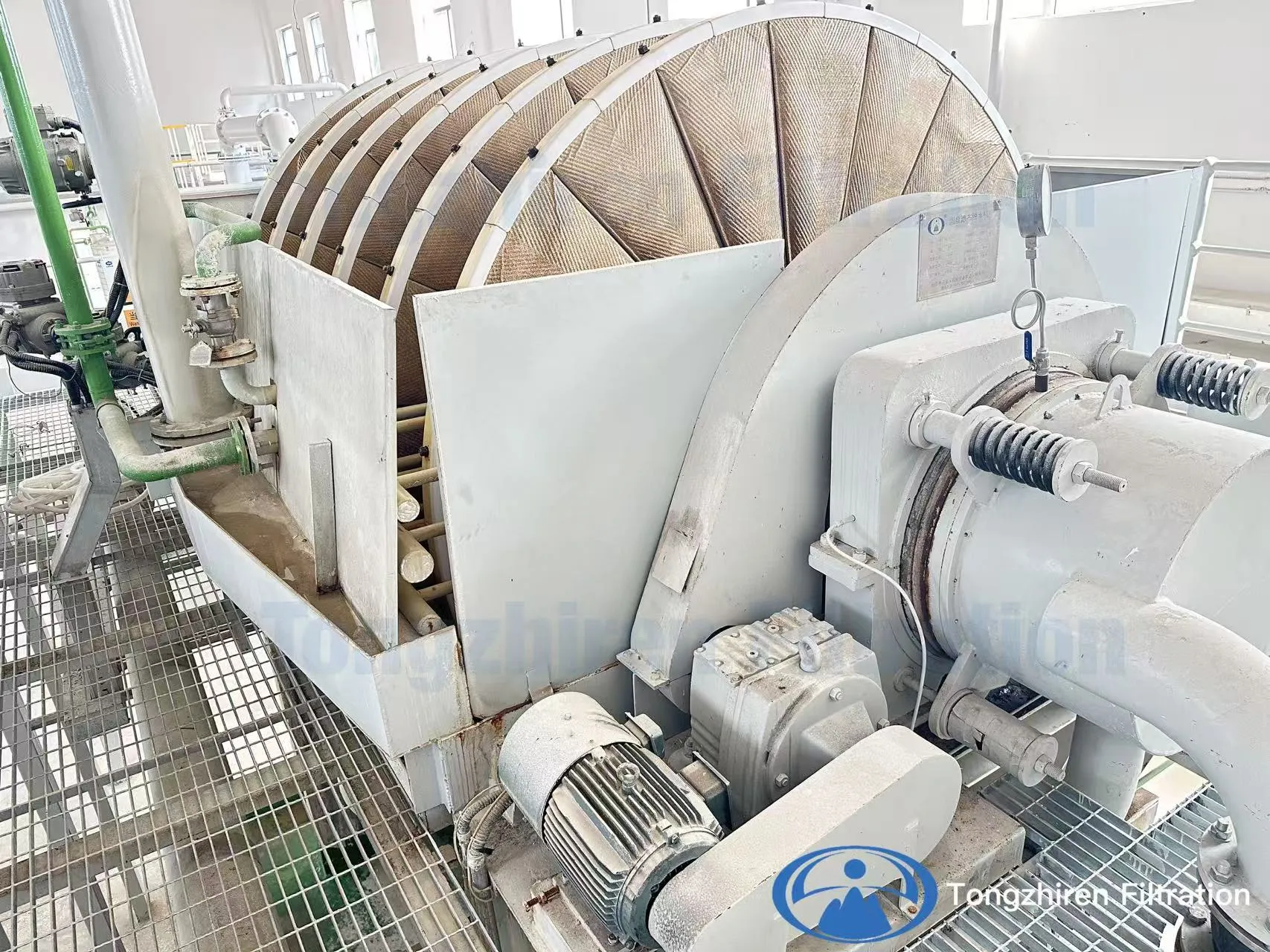
Phosphate concentrate dewatering removes process water after beneficiation so the product can be stored, transported, dried, or sent to phosphoric-acid and fertilizer production. Vacuum filtration can provide continuous solids-liquid separation and water recovery, but the correct filter type depends on particle size, clay content, washing duty, product moisture, corrosion conditions, and the way the cake will be handled.
Can a vacuum disc filter dewater phosphate concentrate? Yes, when representative testwork shows that the concentrate forms a permeable cake, releases cleanly, and reaches the required moisture under vacuum. A vacuum belt or drum filter may be preferred when extensive cake washing or long drying time is required. A pressure filter may be preferred when very fine particles or a demanding moisture target require a higher pressure differential.
The equipment decision should therefore start with the beneficiation flowsheet and product specification, not with a filter name.
Phosphate rock is the principal global source of phosphorus, an essential nutrient used heavily in fertilizer production. Beneficiation may include screening, washing, classification, desliming, grinding, and flotation to separate phosphate minerals from clay, quartz, carbonate, or other gangue.
These wet processes produce concentrate that contains water. Removing part of that water can:
The required moisture is application-specific. Concentrate sent directly into a wet-process phosphoric-acid plant may have a different target from material prepared for storage, shipment, or thermal treatment.
A simplified wet-beneficiation route may include:
Ore preparation → washing/classification → flotation or separation → concentrate thickening → filtration → storage or downstream conversion
The exact route varies with deposit mineralogy. Some phosphate rock requires limited beneficiation, while lower-grade or clay-rich ore may need more intensive washing, sizing, and flotation.
The filter must receive a controlled feed. Thickener underflow that varies sharply in solids concentration changes cake formation and filtration capacity. A properly agitated feed tank can buffer short disturbances, but it cannot correct fundamentally unstable upstream operation.
A vacuum disc filter contains multiple vertical discs mounted on a horizontal shaft. Each disc is divided into sectors covered by filter cloth. As sectors pass through the slurry:
The configuration provides substantial filtration area in a relatively small footprint. However, successful discharge requires sufficient cake thickness and mechanical integrity. Sticky or extremely thin cake can remain on the cloth and reduce effective area.
Vacuum disc filtration deserves evaluation when:
It should not be selected solely because another phosphate plant uses one. Deposit mineralogy and flowsheet chemistry determine performance.
| Process need | Technology commonly evaluated |
|---|---|
| Compact continuous filtration area | Vacuum disc filter |
| Long, visible cake-washing zone | Horizontal vacuum belt filter |
| Flexible cake formation and washing arrangements | Vacuum drum filter |
| Higher differential pressure for difficult fine cake | Pressure filter |
This is a screening comparison, not a final selection rule. Capital cost, utilities, footprint, moisture, wash efficiency, filtrate quality, availability, and maintenance must be compared using the same representative feed.
Clay and fine slimes can block drainage paths, increase cake resistance, and make discharge sticky. Efficient desliming may improve filtration, but its effect on phosphate recovery and grade must also be considered.
Average particle size alone does not describe filtration. The full distribution—especially the finest fraction—helps explain permeability and cloth blinding. Test samples should preserve the actual proportion of fines.
Concentrated feed can support faster cake formation, but very high viscosity may impair distribution. Testwork should identify a practical operating band rather than a single ideal number.
Flotation reagents, dissolved salts, pH, and recycle-water quality can affect particle surfaces, froth carryover, and cloth behavior. Testing washed or chemically altered material that does not match the plant feed can give misleading results.
If residual reagents, chlorides, soluble impurities, or process liquor must be displaced, wash efficiency may become more important than filtration area. Washing should be quantified through a mass balance rather than judged by appearance.
Temperature changes liquid viscosity and can affect filtration rate. Seasonal or process-driven temperature ranges should be represented in design testing.
Use dry-solids capacity and tested specific throughput:
Filter area (m²) = Required dry solids (kg/h) ÷ Tested throughput (kg/m²·h)
The test result must satisfy the target moisture, cake release, and filtrate quality simultaneously. If washing is required, the test must also meet the residual-solute target.
The design basis should include:
Mechanical dewatering is generally less energy-intensive than evaporating the same water thermally. Better filtration can therefore reduce dryer duty. But pursuing the absolute minimum filter-cake moisture may lower filtration throughput or demand disproportionate vacuum energy.
The best operating target minimizes total process cost across thickening, filtration, conveying, drying, water recovery, and production losses. A small moisture reduction is valuable only if its downstream benefit exceeds the extra filtration cost and capacity penalty.
Phosphate concentrate that sticks to the cloth reduces active area and creates uneven cake. Corrective work should check:
More blowback is not always better. Excess air can damage the cake, increase solids in the filtrate, and waste compressed air.
Send the filter supplier:
A representative slurry sample remains the most useful input because it allows the supplier to connect equipment sizing to observable cake behavior.
It is the removal of process water from beneficiated phosphate solids before storage, transport, drying, or chemical conversion.
No. It is a candidate when cake formation, moisture, and discharge are satisfactory under vacuum. Washing duty, ultrafines, and downstream requirements may favor another filter type.
Clay and slimes commonly reduce cake permeability, increase retained moisture, and promote cloth blinding. Their actual impact should be measured using representative feed.
Yes. Removing more water mechanically can reduce thermal evaporation duty, provided the filtration improvement does not create a larger cost or throughput penalty elsewhere.
There is no single result. The design must meet dry-solids throughput, cake moisture, cake release, filtrate clarity, and—when required—cake-washing performance at the same operating point.