
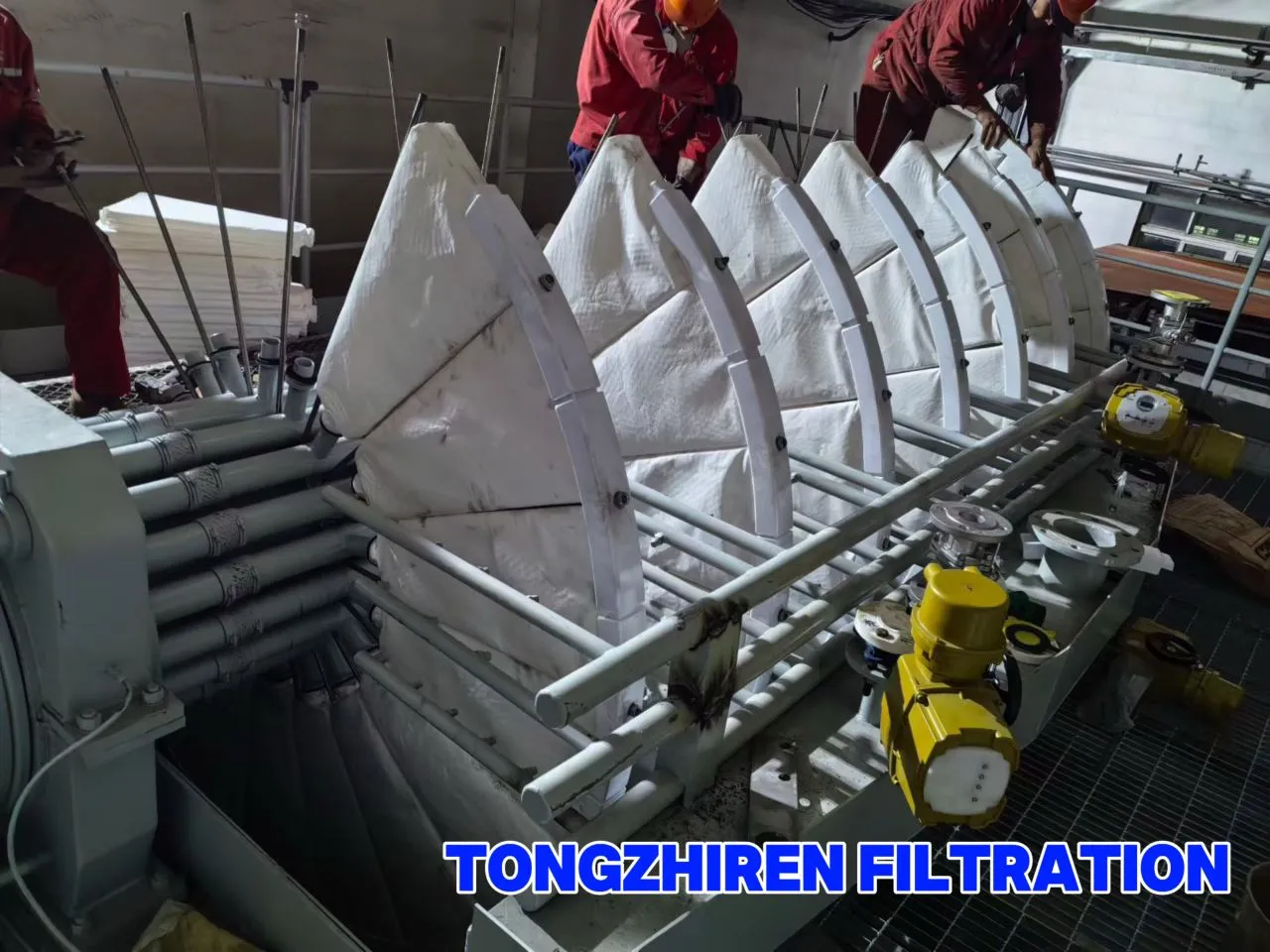
Fine coal dewatering removes water from the small coal particles recovered during coal preparation. For a flotation concentrate, successful dewatering means producing a cake that can be handled and blended while retaining valuable coal and controlling the amount of water carried into the final product.
A vacuum disc filter is one option for this duty. Its suitability depends on how the actual coal slurry forms and drains a cake, particularly as the proportion of ultrafines and mineral matter changes.
Yes. Vacuum disc filters are used for fine coal dewatering where testwork demonstrates acceptable throughput, cake moisture, solids recovery, and discharge. They operate continuously: liquid passes through a cloth-covered sector under vacuum, solids accumulate as cake, and the cake is dewatered and discharged as the disc rotates.
ANDRITZ describes this application in its fine coal vacuum disc filtration brochure. Its published equipment results belong to that supplier's specified conditions; they should not be treated as guarantees for a different coal or filter.
The phrase “coal slurry” does not adequately describe the selection duty. A cleaned flotation concentrate, a mixed fine-coal stream, and a high-ash tailings stream can have different commercial objectives and filtration behavior.
For product coal, the review should connect filtration to saleable recovery, ash specification, moisture, and blending. For tailings, handling and disposal requirements may be the main constraints. Identify the sampling point and downstream destination before requesting a filtration proposal.
Keep these streams separate in test reports. A result obtained on clean flotation concentrate should not be used to size equipment for a combined stream without checking the new mixture.
Small particles have more surface area per unit mass than otherwise comparable larger particles. In a filter cake, fine particles can also occupy the spaces between larger ones and restrict drainage. The complete particle-size distribution therefore matters more than a single average size.
Mineral matter changes the mixture further. ANDRITZ's coal separation guide identifies fine-grain and ash content as factors affecting coal suspension permeability.
Ash is useful information, but it does not identify every mineral or its effect. Two samples with similar ash content can contain different proportions of clay and other minerals. Ask the laboratory to characterize difficult samples rather than assuming that ash percentage alone predicts filtration rate.
For an operating plant, retain samples when a seam blend, classification setting, or flotation condition changes. This helps distinguish a new feed characteristic from a mechanical problem.
Fine-coal cake may be blended with a coarser product before shipment. In that case, the moisture contribution of the fine stream depends on its mass as well as its moisture percentage.
Consider an illustrative blend:
80 wet tonnes per hour of coarse product at 6% wet-basis moisture contain 4.8 tonnes per hour of water.
20 wet tonnes per hour of fine-coal cake at 20% wet-basis moisture contain 4.0 tonnes per hour of water.
The combined stream contains 8.8 tonnes per hour of water in 100 wet tonnes per hour, giving 8.8% wet-basis moisture.
The unweighted average of 6% and 20% would be wrong. These figures are a calculation example, not suggested coal specifications. Real blend evaluation also needs the required ash, quality, and handling characteristics.
If the wet- and dry-basis terms are unfamiliar, use the filter cake moisture calculation guide.
A lower cake-moisture result is not automatically better if more recoverable coal leaves with the filtrate. Collect and analyze both outputs during testwork.
Useful measurements include:
dry-solids feed rate;
cake production and moisture;
filtrate flow and suspended-solids concentration;
ash or other agreed quality measurements for feed, cake, and lost solids;
cake discharge consistency over repeated cycles.
Filtrate solids may have a different composition from the cake. Measuring only total suspended solids will not establish how much combustible material has been lost. The sampling and assay plan should match the recovery question being asked.
The filtrate quality and process-water reuse article explains the related water-circuit issues.
Use representative slurry containing the process water and reagents expected at the filter inlet. Include normal operation and plausible difficult conditions, such as a larger ultrafine fraction or a different seam blend.
For each sample, compare throughput, moisture, discharge, and solids recovery at the same operating point. Record cloth, cake thickness, cycle timing, vacuum conditions, and feed concentration so the result can be reproduced.
Observe whether cake forms evenly and releases across repeated cycles. A short test that produces one satisfactory cake does not establish sustained operation or cloth-cleaning requirements.
Agree on the moisture method with the laboratory. Coal moisture terminology can depend on the test purpose, so a process cake result and a product quality certificate should not be assumed to represent the same measurement without checking their methods and bases.
Vacuum disc filtration is part of a wider fine-coal dewatering selection. ANDRITZ's coal processing overview distinguishes coarse, fine, and tailings duties and presents several equipment types.
For the project comparison, ask each supplier to address the same feed envelope and final-product requirement. Include material recovery, reliable discharge, utilities, floor space, maintenance, and integration with the blend system.
Where a vacuum filter misses the required moisture or handling target, evaluate another suitable technology through testwork. Conversely, an alternative that gives a drier cake should still be assessed for its effect on recovery and total production cost.
Send the dry-solids throughput, feed solids concentration, full particle-size distribution, ash data, process-water information, reagent details, temperature, target moisture, and downstream blending arrangement. State whether the feed is cleaned coal, a mixed product, or tailings.
Include available laboratory results and the variation expected in the mine plan. Contact Tongzhiren Filtration with this information to discuss filtration assessment and equipment selection. Any proposed operating figures should be tied to the tested coal and agreed conditions.
No. The target depends on the coal, customer specification, downstream handling, blending, and achievable separation performance.
Ash content alone is insufficient to predict filtration. Particle size, mineral composition, and the resulting cake structure also matter.
Yes. Measure its flow and solids, and use suitable analysis to distinguish valuable coal from mineral matter where required.
It can provide context, but it should not replace testing of the feed and variability expected for the actual installation.