
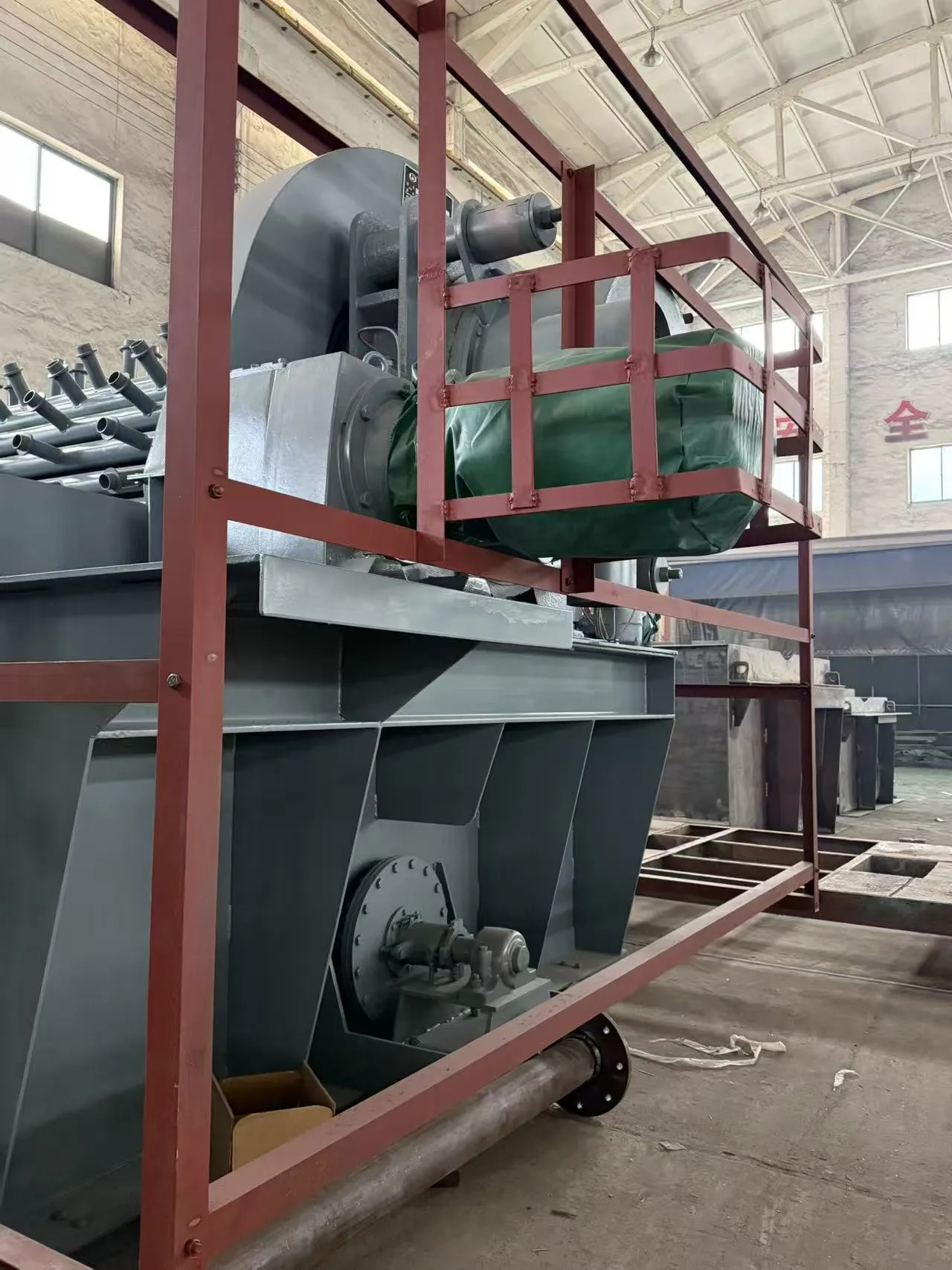
Potash dewatering separates product crystals from the liquid used in wet mineral processing. In a brine circuit, that liquid contains dissolved salts, so filtration must be evaluated through both a solids balance and a solution balance.
For fine potassium chloride concentrate, a vacuum disc filter can be a candidate when the crystals form a cake that drains and discharges reliably. Selection should consider crystal-size distribution, retained brine, product quality, and the requirements of the downstream dryer or other processing stage.
Vacuum disc filters can serve the fine fraction of a potash dewatering circuit. A coarse crystal fraction may be better suited to different equipment. The choice should follow separate testing of the actual fractions and their brine conditions.
In an ANDRITZ potash case study at Belaruskali, the process separated coarse and fine fractions, using a pusher centrifuge for coarse material and a vacuum disc filter for fines. This is an example of an application-specific arrangement, not a universal potash flowsheet or a Tongzhiren installation.
“Potash” covers different products and processing routes. A filter inquiry should identify the principal solid product, its particle-size distribution, and the liquid composition. Potassium chloride flotation concentrate should not be assumed to behave like a different fertilizer salt or a residue from another stage.
K+S describes potassium chloride flotation in a saturated salt solution, followed by dewatering and drying, in its Neuhof-Ellers product overview.
For a selection review, provide a process drawing showing where the slurry originates and where the cake and filtrate go. Identify recycle streams and any intended wash stage. These details help determine what the filter must retain, recover, or remove.
A filter retains suspended crystals while liquid passes through the medium. Dissolved salts travel with that liquid unless a separate process changes their state. A visually clear filtrate can therefore contain significant dissolved material.
Use two related questions when evaluating recovery:
How much suspended product escapes into the filtrate?
How much dissolved product moves with the separated brine, and where is that brine subsequently used?
Filtrate recycled to the process has a different economic role from liquid removed from the circuit. Avoid calling every dissolved salt in the filtrate a final product loss without examining its destination.
Likewise, solids recovered after evaporating a filtrate sample are not necessarily all particles that passed through the cloth. Dissolved salts can remain as residue when water evaporates. Ask the laboratory to distinguish suspended solids from dissolved material.
In a simple loss-on-drying measurement, water is removed while nonvolatile dissolved salts may remain with the dried sample. The resulting moisture percentage can therefore differ from the mass fraction of brine originally held in the cake.
For an illustrative calculation, assume cake contains:
100 kg of product crystals;
20 kg of retained brine;
brine consisting of 15 kg water and 5 kg dissolved salts.
The wet cake weighs 120 kg. If drying removes only the 15 kg of water, its measured wet-basis mass loss is 12.5%. The original retained-brine fraction was 20 / 120, or about 16.7%.
Both figures describe useful but different properties. This example assumes no other mass changes during drying; it is not a prescribed analytical method. Agree on methods suitable for the actual salt mixture and use the moisture reporting guide to keep measurement bases clear.
Testing crystals in fresh water can change the sample compared with testing them in their process liquor. Use representative brine and record temperature, composition, density, and any dilution during transport or preparation.
If cooling, heating, or dilution changes the quantity or size of crystals, the filtration test may no longer represent the original stream. Ask the laboratory to document visible crystallization or dissolution and discuss how the test conditions relate to plant operation.
Where chemistry varies, test the relevant range. The purpose is to understand the process response, rather than produce one favorable filtration result under conditions the plant cannot maintain.
Cake washing may be proposed to displace impurities or change retained liquor composition. In a soluble-salt process, the wash liquid can also affect product dissolution and the amount of liquid returned to the plant.
Define the desired impurity reduction, acceptable product loss, wash-liquid chemistry, and destination of the wash filtrate before selecting a wash arrangement. Do not assume that fresh water is appropriate simply because it is readily available.
If washing is central to product quality, compare equipment and wash methods that can provide the necessary contact and displacement. A compact dewatering arrangement alone does not establish adequate washing performance.
Reducing retained liquid can reduce the water sent to a dryer. However, the dryer feed also contains the salts carried in that liquid, and their effect on final composition should be accounted for.
Review the cake's consistency, feed rate, handling, and impurity requirements with the downstream process team. Compare results at equivalent production and composition, rather than comparing moisture figures in isolation.
A useful test report records cake mass, moisture method, product assay, filtrate volume, dissolved composition where relevant, suspended-solids loss, and repeatable discharge. This provides more information than a capacity figure alone.
Give the supplier the actual liquid chemistry and temperature when discussing wetted materials, seals, cloth, and cleaning. Material selection should follow the complete conditions, including cleaning and periods when liquor may remain in the equipment.
Request a proposed approach to inspecting and cleaning areas where salt deposits might develop. The method should be compatible with both the equipment and the process-water balance; a general instruction to flush the system leaves these questions unanswered.
Supply crystal identity, product assay, size distribution, solids throughput, slurry concentration, brine analysis, temperature range, retained-liquid or moisture target, and wash requirements. Include the downstream drying or handling arrangement and the filtrate destination.
Contact Tongzhiren Filtration with these details to discuss whether vacuum disc filtration warrants testing for the proposed stream. For comparing equipment packages, refer to the supplier quotation scope checklist.
They are used in fine-potash applications, but suitability for a particular stream depends on crystal behavior, brine conditions, discharge, and the required product specification.
No. Clear filtrate can contain dissolved salts. Assess suspended crystals and dissolved material separately.
Only if it represents the intended process or an explicitly studied condition. Changing the liquor can alter the crystal population and make results unrepresentative.
Not necessarily. Dissolved salts may remain after a drying test, so measured mass loss can be lower than the original mass of retained brine.