
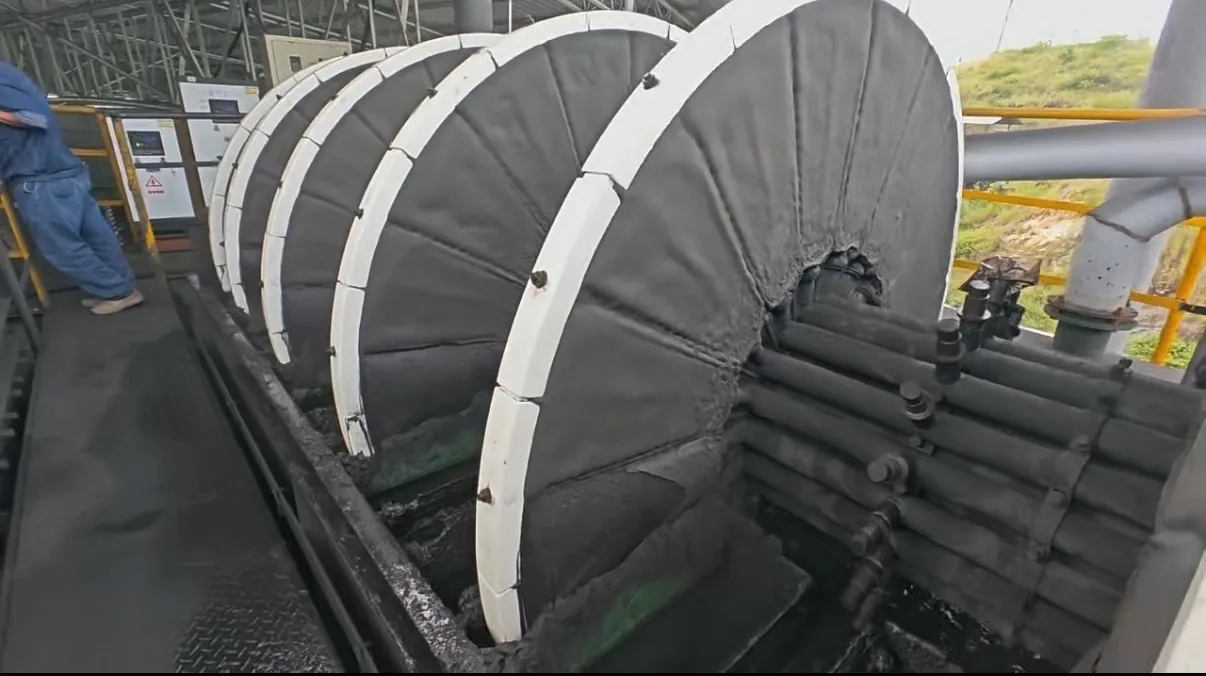
A flocculant that produces fast settling in a cylinder is not automatically the best treatment for a vacuum disc filter. Settling and filtration measure different responses. The filter needs a cake that drains, retains solids, and releases consistently at the required production rate.
Evaluate a proposed reagent through a filtration trial that reproduces the slurry, water chemistry, mixing, and handling conditions expected at the machine. Compare the complete result with an untreated or current-treatment baseline.
Yes, some slurries respond to flocculants that aggregate fine particles and change the structure of the resulting cake. The benefit is application-specific and depends on reagent selection, preparation, dose, and how the treated slurry reaches the filter.
Metso's concentrate filtration guide identifies flocculants as a potential aid to vacuum filtration when the slurry can be handled gently. This supports testing the treatment under realistic handling conditions rather than assuming that the largest visible flocs will produce the best cake.
The terms are sometimes used loosely in equipment discussions, but they do not necessarily describe the same product or mechanism. A flocculant promotes aggregation. Other filtration reagents may target different aspects of water release or surface behavior.
SNF's mining reagent brochure distinguishes flocculants and coagulants from products described as filtration dewatering aids. Request the exact product identity, intended function, and preparation requirements from the reagent supplier.
A trial record should name the product and its concentration. Descriptions such as “polymer added” or “dewatering chemical used” are not enough to reproduce a result.
State which result needs improvement: dry-solids throughput, cake moisture, suspended solids in filtrate, discharge consistency, or another defined requirement. Record the current operating point and acceptable limits for the other results.
For example, a treatment that improves filtrate clarity but lowers production may or may not be worthwhile. The decision depends on the value of recovered solids and the plant's capacity requirement.
Keep upstream requirements visible. A reagent trial should not compromise flotation performance or water reuse merely to improve an isolated filtration result. Coordinate changes with the process team responsible for the connected circuit.
Specify whether the dose is expressed as active reagent or supplied commercial product per unit of dry solids. Also record the strength of the prepared dosing solution.
Consider an illustrative calculation:
These are calculation examples, not recommended operating values. A volumetric dosing rate also requires the solution density. If the dose refers to commercial product rather than active content, the calculation must use that basis consistently.
The dilution liquid is part of the process feed. Record it, particularly when comparing tests at different doses.
Use representative slurry and actual process water where practical. Record feed concentration, temperature, particle-size information, pH, and existing reagents. The slurry sampling guide explains how to preserve relevant sample conditions.
Run a baseline using the current treatment or no additional treatment, depending on the question. Then test a justified dose range selected with the reagent supplier. Include repeat measurements so ordinary sample variation is not mistaken for an improvement.
Where solution addition changes feed dilution, account for that difference. A change attributed to polymer may partly reflect a change in slurry concentration.
Document where reagent is added and what happens afterward. A laboratory beaker transferred gently into a test filter may not represent slurry passing through a pump, valve, and agitated tank before reaching the plant filter.
Discuss how the laboratory will represent mixing, elapsed time, and relevant handling. Keep the method consistent between doses, and explain any unavoidable difference from the proposed plant arrangement.
Do not remove necessary slurry mixing simply to preserve floc appearance. Solids suspension and distribution still have to function. The trial should identify a workable combination of conditioning and transport.
| Result | What the trial should establish |
|---|---|
| Throughput | Dry-solids production under the tested cycle conditions |
| Cake moisture | Moisture measured by the same method and reporting basis |
| Filtrate quality | Solids concentration and, where needed, the value of lost material |
| Cake release | Whether the cake discharges consistently over repeated cycles |
Keep cloth, cake-forming conditions, and available vacuum controlled or explicitly documented. Record cleaning between trials to avoid confusing reagent effects with changes in media condition.
The cake moisture guide helps maintain a consistent reporting basis. The filtrate quality guide explains why clear appearance alone may not answer the process-water question.
Avoid reporting the highest throughput from one dose and the lowest moisture from another as a single performance claim. Identify which requirements were achieved together.
Include reagent cost, dilution-liquid demand, cleaning requirements, and downstream effects. If a treatment only works at one narrowly controlled condition, test whether that condition can be maintained during normal feed variation.
Where a dose increase stops improving the relevant result, investigate rather than continuing to increase it. The useful question is which operating window meets the plant requirement reliably, not which sample has the most visible aggregation.
Before a plant trial, agree on the dosing equipment, preparation method, measurement plan, and conditions for returning to the established process. Use the same product identity and dose basis as the laboratory work.
Compare periods with similar feed and preserve the records of disturbances. A favorable short run does not establish sustained cloth behavior or the effect of reagent returning through the water circuit.
Contact Tongzhiren Filtration with the baseline filtration results, reagent information, and proposed dosing location to discuss the equipment-side requirements alongside the reagent supplier.
No. Settling performance does not establish cake moisture, filter throughput, media behavior, or discharge.
Use an explicitly agreed basis. A dry-solids basis makes comparison clearer when slurry concentration varies, but the active-versus-commercial-product distinction must also be stated.
No. Select a tested operating window using the combined filtration results and process cost.
Possible differences include feed chemistry, dilution, reagent preparation, mixing, handling, and the time between dosing and filtration. Compare these before drawing a conclusion.