


West Chuangxin Road, Sunshine Industrial Park, Donggang Town, Xishan District, Wuxi City, China
A candle filter, also known as a candle pressure filter, is an industrial filtration system designed for the efficient separation of fine suspended solids from liquids. By combining pressure filtration with a large filtration surface area, candle filters enable the production of high-clarity filtrate while recovering valuable solid particles.
Candle filtration technology is widely used in industries where fine particle filtration, high purity liquids, and reliable filtration cycles are required.
A candle filter is a pressure filtration device that separates solid particles from liquids using vertically mounted cylindrical filtration elements known as filter candles.
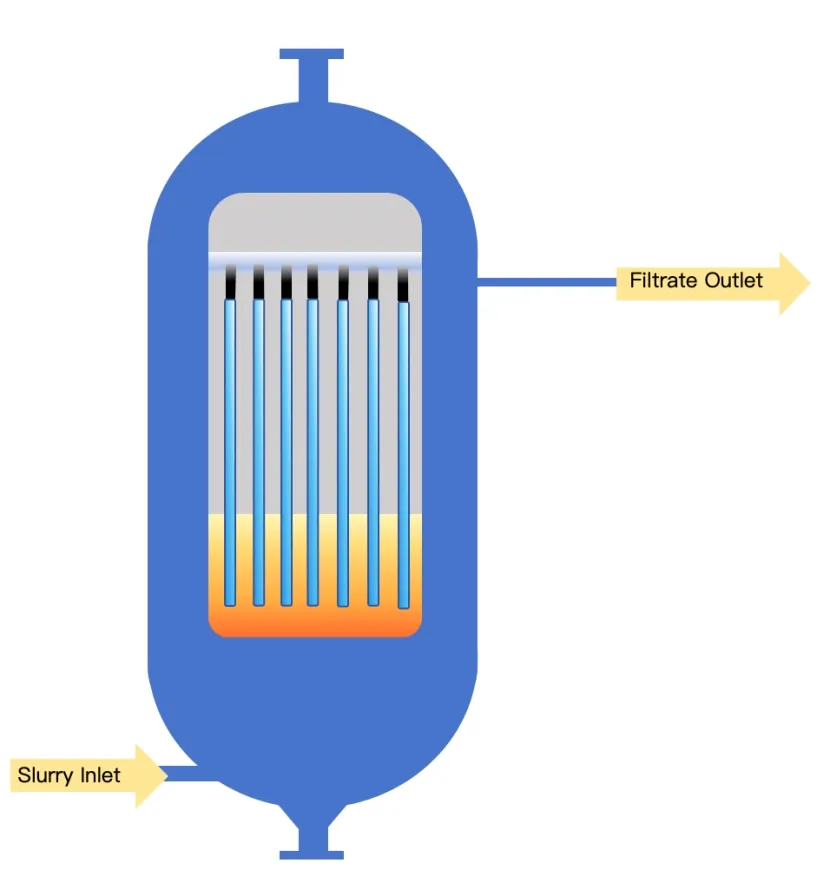
Inside the pressure vessel, multiple filter candles are arranged in parallel. Each candle is covered with a filtration medium such as filter cloth or mesh. Together they create a large filtration surface area within a compact system.
During operation:
1. Slurry containing suspended particles enters the pressure vessel.
2. Liquid passes through the filter medium covering each candle.
3. Solid particles accumulate on the outer surface of the candle elements.
4. A layer of solids known as the filter cake gradually forms.
5. Clean liquid (filtrate) passes through the candle and exits the filtration system.
6. Once the filtration cycle reaches its limit, the filter cake is removed and the filtration process begins again.
This process allows candle filters to achieve high filtration precision even when handling extremely fine particles.
The candle filtration process is based on pressure-driven cake filtration.
Slurry containing suspended particles is pumped into the filter vessel under controlled pressure.
Liquid passes through the filtration medium covering the candle elements while solid particles are retained on the surface.
As filtration continues, particles accumulate to form a filter cake layer.
The filter cake gradually increases in thickness, which improves filtration precision and reduces the passage of fine particles.
Filtered liquid flows through the internal channels of the candle elements and exits through the filtrate outlet.
When filtration resistance reaches the target level, the filtration cycle ends and accumulated solids are discharged automatically.
A typical candle filtration system consists of several key components designed to ensure reliable and efficient filtration.
The pressure vessel is a sealed container that houses the filter candles. It is designed to withstand the operating pressure required for filtration.
Filter candles are cylindrical filtration elements that provide the primary filtration surface.
Each candle typically consists of:
l internal structural support
l filtration medium
l filtrate drainage channel
Multiple candles are installed inside the vessel to maximize filtration area.
Filtered liquid passing through the candle elements is collected by a manifold system and directed to the filtrate outlet.
After filtration, accumulated solids are removed from the candle surfaces through mechanical or hydraulic discharge methods.
Modern candle filtration systems can be integrated with automated control systems to regulate:
n filtration pressure
n cycle duration
n discharge timing
Automation improves process stability and reduces manual intervention.
Candle filters are widely used in industries requiring fine particle separation and high product purity.
Candle filters can be used in various stages of battery material manufacturing, including filtration of slurry and precipitation products.
Typical uses include:
l precursor filtration
l cathode material processing
l high-purity solution clarification
In recycling processes for lithium-ion batteries, candle filters may be used in hydrometallurgical circuits for:
l leachate clarification
l precipitation product filtration
l recovery of valuable metal compounds
Candle filtration technology is commonly applied in metal extraction processes for:
l clarification of leach solutions
l filtration of precipitated metal compounds
l recovery of valuable metals
Typical metals include copper, nickel, cobalt, and other strategic materials.
Candle filters are widely used in chemical production processes requiring precise separation of solids from liquids.
Applications include:
1. catalyst recovery
2. filtration of chemical intermediates
3. purification of liquid products
For applications requiring high purity and hygienic filtration environments, candle filters may be used for:
1. liquid clarification
2. removal of fine impurities
3. filtration of process liquids
Compared with many conventional filtration technologies, candle filters provide several advantages.
Candle filters can remove extremely fine suspended particles, producing high-clarity filtrate.
Multiple candle elements provide a large filtration area within a relatively small footprint.
The pressure filtration mechanism enables efficient separation of micron-scale particles.
The sealed vessel design helps maintain process control and reduces environmental exposure.
Modern systems can be configured for automated filtration cycles, reducing labor requirements.
Different filtration technologies serve different process needs. Candle filters are particularly effective in applications involving fine particles and high clarity filtrate.
Plate filter presses are widely used in solid–liquid separation.
Plate Filter Press advantages:
l suitable for high solids concentration
l capable of producing dry filter cakes
Limitations:
l intermittent operation
l large equipment footprint
l historically required manual plate handling
n However, modern filter press systems can now be equipped with automated plate-shifting and cake discharge mechanisms, similar in concept to automated discharge systems used in continuous filtration equipment such as vacuum disc filters. These upgrades significantly reduce manual intervention and improve operational efficiency.
Candle Filter advantages:
l compact system design
l high filtration precision
l automated filtration cycles
l suitable for fine particle filtration
Vacuum disc filters are often used in large-scale mineral processing.
Vacuum Disc Filter advantages:
l continuous filtration
l suitable for large slurry throughput
Limitations:
l limited pressure differential
l less effective for very fine particles
Candle Filter advantages:
l pressure filtration improves fine particle capture
l higher filtrate clarity
l suitable for precise filtration processes
Bag filters are simple filtration devices used for coarse particle removal.
Bag Filter advantages:
l simple design
l low initial cost
Limitations:
l limited filtration area
l frequent bag replacement
l not suitable for heavy solids loading
Candle Filter advantages:
l large filtration area
l stable filtration performance
l suitable for fine particle applications
Selecting the appropriate candle filtration system depends on several process parameters.
Fine particles generally require filtration media with smaller pore sizes.
Higher solids concentrations may influence filtration cycle time and cake thickness.
Operating pressure affects filtration rate and cake formation.
Viscosity, temperature, and chemical composition of the liquid can affect filtration performance.
Process considerations may include:
l desired filtrate clarity
l solids recovery requirements
l washing requirements
l automation level
Careful evaluation of these factors helps ensure optimal filtration system design.
A candle filter is used for solid–liquid separation, particularly when fine suspended particles must be removed from liquids to produce clear filtrate or recover valuable solids.
A candle filter works by pumping slurry into a pressure vessel containing cylindrical filter elements. Liquid passes through the filter medium while solids accumulate on the surface to form a filter cake.
The filtration elements used in the system are long cylindrical structures resembling candles, which is why the equipment is referred to as a candle filter.
Industries that commonly use candle filtration systems include:
l battery material production
l lithium battery recycling
l hydrometallurgy
l chemical processing
l food and pharmaceutical manufacturing
Depending on the filtration medium used, candle filters can remove very fine suspended solids, often in the micron range.
Yes. Candle filtration systems can be constructed from materials suitable for corrosive chemical environments depending on process requirements.
Cake filtration is a filtration process in which solid particles accumulate on the filter surface to form a layer called a filter cake, which improves filtration efficiency during the filtration cycle.