
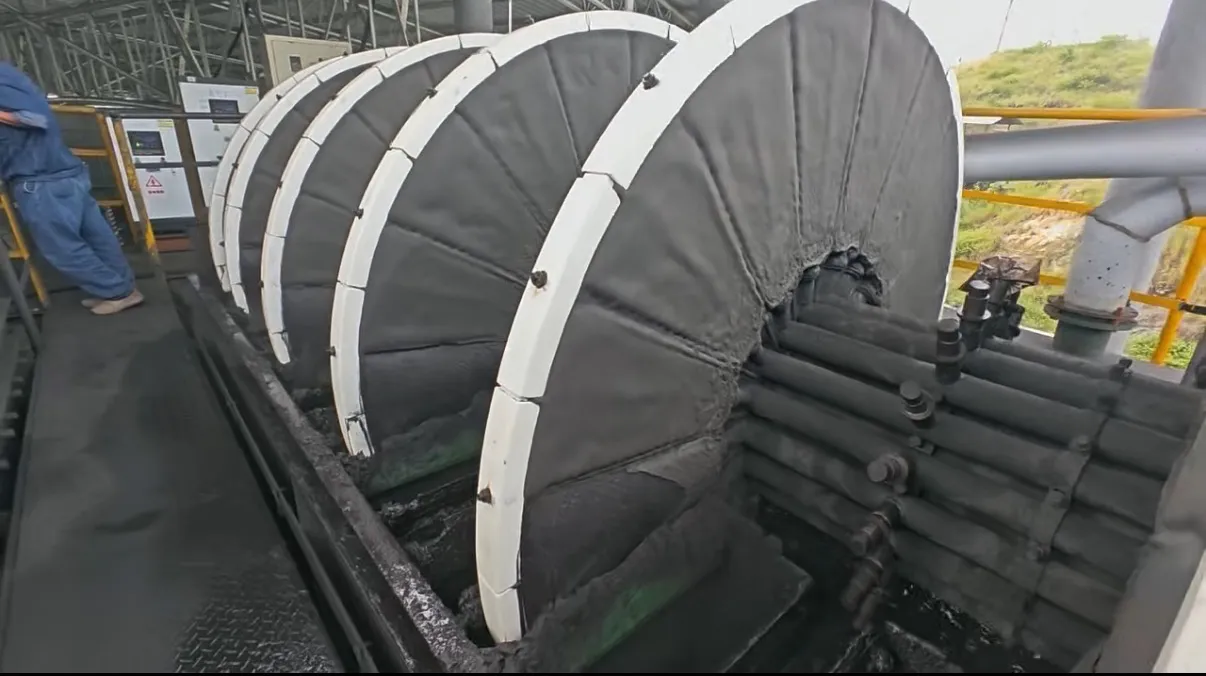
A median particle size cannot determine whether a vacuum disc filter will achieve the required moisture and production rate. For equipment selection, request the full particle-size distribution, the measurement method and reporting basis, and filtration tests on representative slurry. Two feeds with the same D50 can have different fine fractions and different dewatering behavior.
Particle-size data helps describe the material being tested. It does not replace a test of how that material forms, dewaters, and releases as a filter cake.
These values identify sizes below which specified proportions of a sample fall. The proportion must have a stated basis: volume, mass, and number distributions are not interchangeable.
For volume-based results, Dv10, Dv50, and Dv90 are the diameters below which 10%, 50%, and 90% of the measured particle volume falls. Dv50 is the volume median, not an arithmetic average. Malvern Panalytical explains these definitions in its guide to particle characterization.
When a report says only “D50,” ask the laboratory to confirm the basis, technique, and units. A number without those details is difficult to compare with a previous sample or a supplier's test report.
Consider two hypothetical volume-based distributions:
| Illustrative sample | Dv10 | Dv50 | Dv90 |
|---|---|---|---|
| A | 8 µm | 35 µm | 90 µm |
| B | 2 µm | 35 µm | 140 µm |
Both have a median of 35 µm, but sample B extends further at both reported ends of the distribution. These invented values illustrate why a shared median does not describe the same feed. They are not plant measurements, filter selection limits, or evidence that one sample will necessarily perform worse.
Request the distribution curve to examine the differences in more detail. Then compare filtration results from the corresponding samples. Avoid using the table alone to predict capacity or final moisture.
Particle size is one influence on the cake structure through which liquid and air must move. Mineralogy, particle shape, and surface chemistry also matter. A size report cannot describe all of those properties.
Metso's concentrate filtration guide discusses the relationship between pore size, capillary pressure, and dewatering, alongside the influence of grade and surface chemistry. These principles explain why a universal particle-size cutoff is an incomplete basis for choosing filtration equipment.
For a project inquiry, describe the mineral concentrate or tailings stream, ore blends, feed solids concentration, process-water conditions, and known changes in reagent practice. Keep this information attached to the laboratory sample identification.
A comparison is stronger when both samples were measured using a consistent, documented method. Ask the laboratory to record the sampling and preparation steps, instrument method, and any dispersant or sonication used.
Also clarify the purpose of the measurement. A report intended to characterize dispersed particles may answer a different question from an observation of aggregates in the operating slurry. Have the laboratory explain which condition its procedure represents and how to interpret it for the filtration study.
Do not independently alter preparation steps to obtain a preferred size result. If methods differ between reports, preserve both methods and ask for a qualified interpretation before treating the difference as a plant change.
Descriptions such as “mostly fine” or “90% passing 400 mesh” leave questions unanswered. Ask for the aperture in micrometres, the sieve standard where relevant, the test method, and whether the passing fraction is mass-based or another basis.
A sieve result and a laser-diffraction percentile may describe different measurement quantities. Keep the original labels when sending data to a supplier rather than relabeling every result as D90.
The aim is a traceable description of the tested material. Extra precision in a quotation does not help if it conceals uncertainty about the underlying method.
Select samples that represent the design duty and meaningful operating variations. These might include the normal ore blend and a known difficult blend, provided their identities and collection conditions are documented.
For each sample, connect the size report to its filtration test record. Compare formation time, cake thickness, dewatering conditions, final moisture, filtrate solids, and release behavior using the agreed test procedure. Keep changed variables visible rather than comparing isolated best results.
The representative slurry sampling guide covers sample collection. The filter capacity calculation guide explains how measured filtration capacity enters equipment sizing.
If one sample requires different conditions to meet the target, ask what that means for the operating range and equipment selection. A single successful test should not silently become a guarantee for every future blend.
Send the full distribution in its original format, units and reporting basis, method details, sample identity, collection conditions, and available mineralogical information. Include the required dry-solids throughput, cake moisture basis, filtrate requirements, and the range of feed conditions the plant expects.
Where the size data is old or its origin is unclear, identify that limitation. A fresh representative sample may resolve more uncertainty than a detailed calculation using an unidentified report.
Contact Tongzhiren Filtration with the slurry information and available test results to discuss the data needed for a filter selection review.
No. It describes one point in the distribution. Selection also needs the wider feed characteristics and representative filtration results.
No. It is a reason to investigate the fine fraction and test behavior, not a standalone technology-selection rule.
Only after checking the reporting basis, method, preparation, and sample identity. Differences in those conditions can complicate the comparison.
No. The report describes size under its measurement method. A representative slurry sample allows the filtration behavior to be evaluated.