
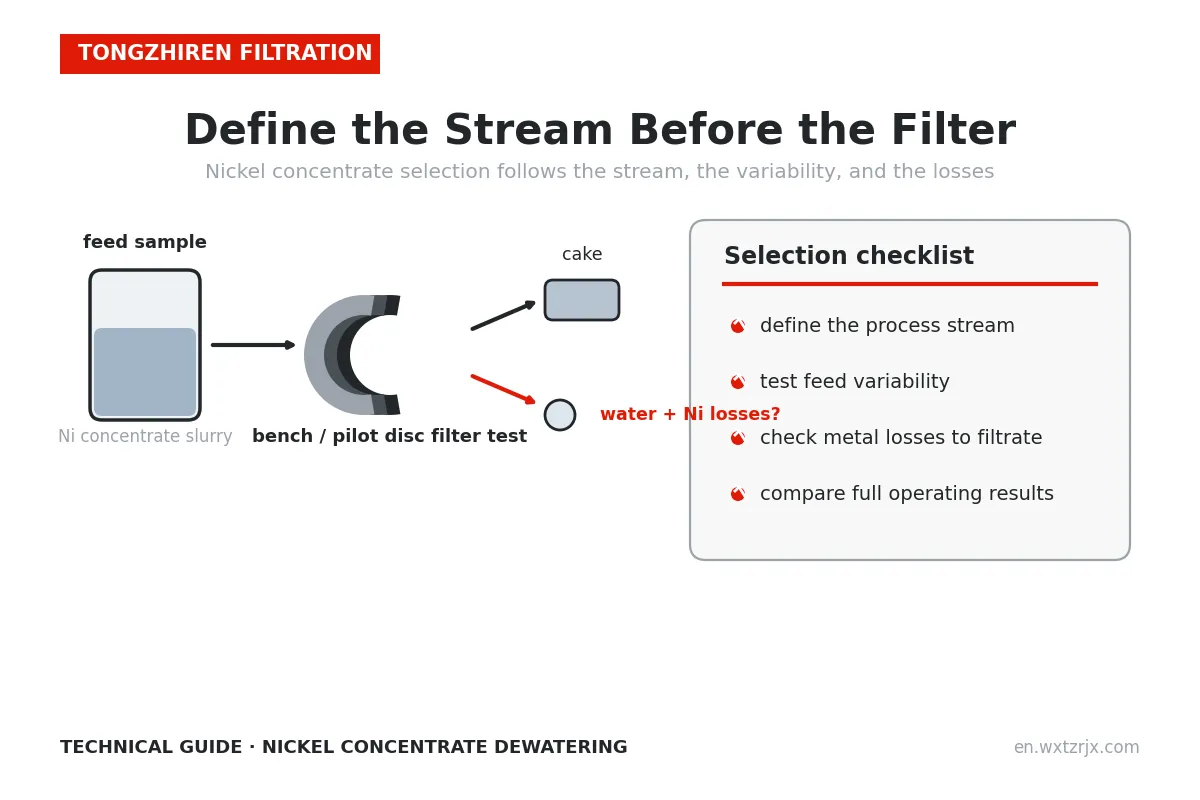
Nickel concentrate dewatering removes liquid from an upgraded mineral product so it can meet the requirements of storage, handling, transport, or the next processing stage. The word “nickel” alone is not enough to select the filter.
A flotation concentrate, a laterite-processing residue, and a precipitated nickel intermediate are different streams. Their solids, liquor chemistry, and required product properties can lead to different equipment choices. Start by identifying exactly what the plant needs to filter.
Vacuum, ceramic disc, and pressure filtration may be candidates, depending on representative test results and the product requirement. Selection should establish dry-solids production, cake moisture, solids recovery, discharge behavior, and any washing requirement at the same operating point.
Metso lists nickel among example applications in its CC ceramic filter brochure. That establishes a documented application for that technology; it does not prove that every nickel slurry is suitable for a ceramic filter or a conventional cloth-covered disc filter.
Record the flowsheet location, principal solids, and liquid composition. Make clear whether the stream is a concentrate intended as product or a residue from a recovery process.
| Stream description | Selection information to establish |
|---|---|
| Nickel-bearing flotation concentrate | Mineralogy, grind, reagent history, product handling, and moisture requirement |
| Leach residue | Liquid chemistry, temperature, washing duty, and residue destination |
| Precipitated nickel intermediate | Product identity, particle behavior, purity target, and suitable filtration method |
| Tailings | Disposal or reuse requirement and expected variability |
This distinction matters when reading supplier references. For example, Metso's Huayou nickel-project announcement concerns tailings filtration for a laterite nickel project. It should not be presented as evidence of performance on saleable nickel flotation concentrate.
Ask suppliers to identify the material behind any proposed reference and explain how it relates to the actual duty.
Specify the condition required at the filter outlet and the point at which it will be measured. Include moisture basis, handling behavior, product quality, and the acceptable quantity of solids in filtrate.
A filter-discharge sample and a sample taken after storage do not necessarily represent the same condition. Additional water, drainage, or mixing between those points can affect the comparison.
Where transport requirements apply, use the product-specific requirements supplied by the responsible parties. Do not copy a generic moisture percentage from another mineral or installation into the filtration specification.
The cake moisture reporting guide helps keep laboratory and plant results on the same basis.
Prepare samples that represent normal production and credible difficult conditions. Identify ore blends, grind changes, mineralogical variation, and changes to process water or reagents that may affect the feed.
For each sample, record the complete particle-size distribution, solids concentration, temperature, and relevant chemistry. Preserve the actual liquor and reagent history where practical.
Metso's general concentrate filtration guide emphasizes material variability and selecting technology through filtration tests. The useful project question is how each candidate performs across the expected feed range, not only on the easiest sample.
Follow the representative slurry sampling guide when preparing material for a supplier or laboratory.
Filtrate clarity is part of the recovery assessment. Measure filtrate flow, suspended solids, and the relevant assay of those solids rather than relying only on visual appearance.
For an illustrative calculation, assume:
The stream carries 20 kilograms of suspended solids per hour, containing 1.6 kilograms of nickel per hour. These are example values, not a plant result or an acceptable loss limit.
The destination matters. Material recycled within the process is not automatically a final loss from the plant. Also distinguish suspended nickel-bearing solids from nickel dissolved in the liquor; a filter's solids capture does not describe dissolved-metal recovery.
For each candidate, ask for the result at the required production and moisture together. Include cake release, filtrate quality, utilities, media cleaning, and any relevant wash performance.
The technology comparison article explains conventional vacuum disc, ceramic, and pressure filtration. For a nickel project, use it as a framework for questions rather than as a substitute for testwork.
If a ceramic configuration is proposed, evaluate the selected medium's compatibility and cleaning requirements. If a cloth-based vacuum filter is proposed, evaluate sustained cake formation and release. If a pressure filter is proposed, include the complete cycle when assessing production.
No single catalogue area or peak test result answers all three questions.
If the process must remove retained liquor or a soluble impurity, define that requirement independently of moisture. State the intended wash liquid, final product limit, acceptable product loss, and wash-filtrate destination.
Check whether the proposed equipment actually includes cake washing or only media cleaning. The cake washing versus cloth washing guide explains that distinction.
This is especially important when comparing a flotation concentrate with a chemically processed stream. Similar nickel grades do not imply similar liquid chemistry or washing needs.
Confirm that feed delivery, filtrate removal, utilities, and cake handling support the proposed operating point. Include the capacity and reliability of shared equipment when comparing alternatives.
A filter that reaches its test target may still interrupt production if the receiving conveyor or filtrate system cannot handle its discharge. Ask suppliers to state the station boundary and identify excluded auxiliaries.
Use the quotation scope checklist to compare equivalent packages. Keep design allowances and uncertain feed assumptions visible in the offer.
Send the stream identity, flowsheet, dry-solids rate, operating hours, feed variability, mineralogy, particle-size data, liquor chemistry, target moisture, and cake destination. Include filtrate-recovery and washing requirements where applicable.
Contact Tongzhiren Filtration with this information to discuss whether vacuum disc filtration warrants testing for the proposed nickel stream and what evidence is needed to compare it with other options.
Not directly. The material, product objective, and filtration behavior may differ. Use representative concentrate testwork.
No. Grade alone does not describe particle size, cake structure, surface chemistry, or liquor properties.
No. Assess suspended solids with suitable analysis and distinguish dissolved material. Include the filtrate destination in the recovery balance.
The candidate must meet the required production, moisture, recovery, and handling conditions together over the agreed feed range.