
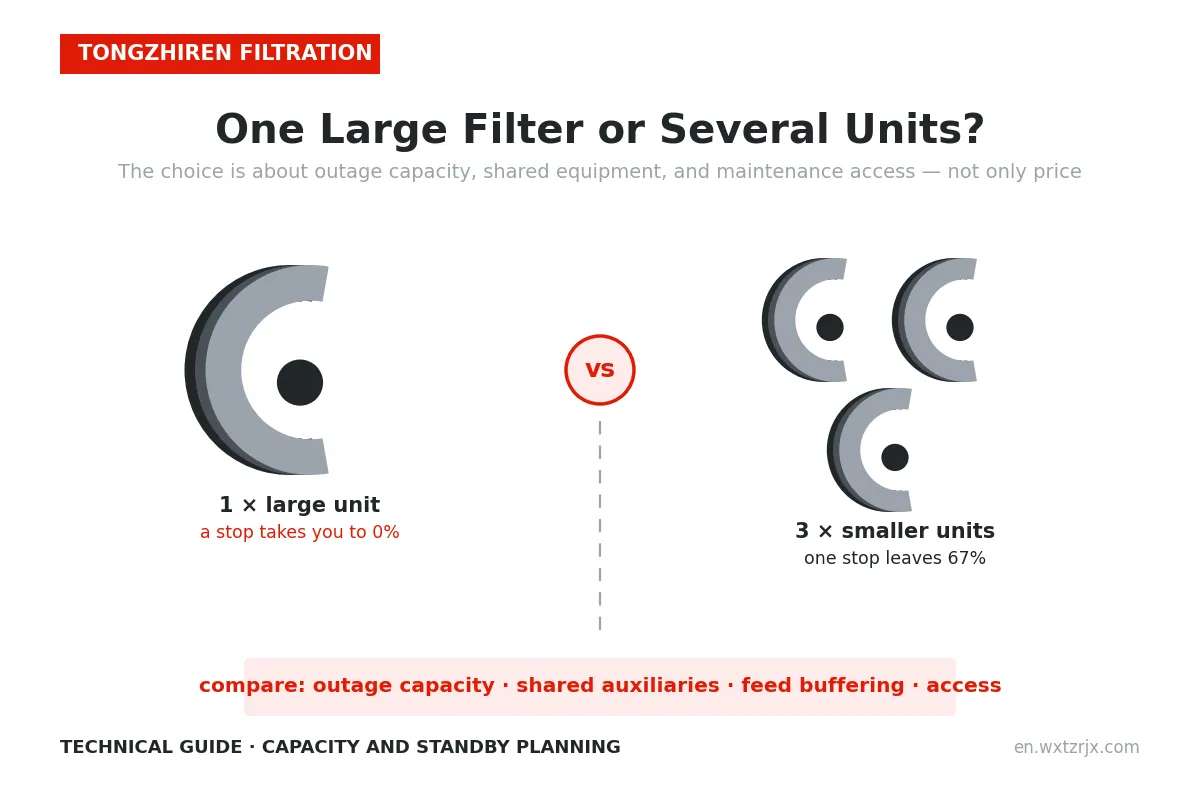
One large vacuum disc filter may offer a simpler equipment arrangement, while multiple units may provide more operating flexibility. The decision depends on how much production the plant must maintain during maintenance or a failure, not only the total installed filtration area.
Compare normal operation, one-unit-out operation, and the behavior of shared auxiliaries. Two filters can still lose all production if both depend on the same unavailable feed pump, vacuum system, conveyor, or power supply.
Two filters can reduce the production lost when one filter is unavailable, but they do not automatically provide full standby capacity. If both are required to meet normal demand, taking either out of service still creates a shortfall.
Define the minimum production required during an outage and confirm how the remaining equipment will deliver it. Treat “multiple units” and “full redundancy” as separate claims.
Metso's Filtration Plant Unit overview describes filters together with feed tanks, pumps, conveyors, controls, and ancillary equipment. That station-level view is useful when deciding which equipment must remain available.
Assume an illustrative duty of 80 dry tonnes per hour. Each capacity below is assumed to be achievable on the specified feed at the required moisture.
| Configuration | Total installed capacity | Capacity with one filter unavailable |
|---|---|---|
| One 80 t/h filter | 80 t/h | 0 t/h |
| Two 40 t/h filters | 80 t/h | 40 t/h |
| Three 40 t/h filters | 120 t/h | 80 t/h |
The third arrangement can meet the example duty with one unit unavailable, provided the remaining station supports that operation. Two 80 t/h filters could also cover the duty with one unavailable, but would have a different installed capacity, cost, and operating arrangement.
These are arithmetic examples, not equipment recommendations. Actual filter capacity must be supported by representative testwork and the chosen operating conditions.
N+1 commonly describes the number of units needed for the duty plus one additional unit. The phrase is incomplete unless the duty, per-unit capacity, and relevant auxiliaries are defined.
For the three-by-40 t/h example, two filters provide the required 80 t/h and one is additional. If difficult feed reduces each filter's capacity, two operating units may no longer meet the duty.
Ask whether the claim covers normal feed only or the agreed design envelope. Also specify whether standby equipment is ready for immediate operation or requires preparation before use.
List the services shared between filters and ask what happens if each becomes unavailable. Include:
Multiple units may share equipment economically, but the resulting dependency should be explicit. A common conveyor shutdown can limit all filters regardless of how much filtration area is installed.
The supplier scope checklist helps identify where package responsibilities meet. Use it to define which supplier must check the proposed one-unit-out operating case.
A feed buffer can cover a temporary difference between incoming production and available filtration. Its useful duration depends on usable storage and the accumulation rate.
Suppose an illustrative outage leaves a shortfall of 40 dry tonnes per hour. If the buffer has usable capacity equivalent to 20 dry tonnes at the relevant slurry conditions, it covers:
20 / 40 = 0.5 hours
That is 30 minutes under constant conditions. It is not a general storage recommendation or a safe operating allowance. Tank volume, slurry concentration, mixing, permitted levels, and other constraints must be checked separately.
Do not count the entire geometric tank volume as available buffer. Also explain how accumulated material will be processed afterward. A station with no spare production capacity may be unable to recover the backlog while normal feed continues.
A plant operating at variable production may benefit from switching units in or out of service. However, each filter still needs a suitable operating range and feed arrangement.
Ask how slurry will be distributed when one, two, or all units operate. Confirm whether the auxiliaries can follow those conditions and whether an idle unit needs a defined shutdown or preservation procedure.
More equipment also means more components to inspect and maintain. Compare the actual maintenance workload and available skills rather than assuming that a larger unit count automatically reduces effort.
Check whether one filter can be isolated and serviced while adjacent equipment remains in operation under the approved plant procedures. A shared platform, lifting route, or transfer arrangement may affect the intended maintenance plan.
Review the complete removal path for major components. Space saved by tightly grouping filters may reduce the flexibility expected from having separate units.
Use the filter station layout guide to review access and the spare-parts guide to assess common components and stock requirements. Similar model names do not prove that every spare is interchangeable.
Include equipment, auxiliaries, foundations, installation, controls, maintenance, and outage consequences. Keep the assumed value of lost production visible and distinguish production that can be recovered later from permanent loss.
For future expansion, identify what must be installed now and what can genuinely be added later. An empty floor position does not by itself reserve sufficient pumping, electrical, vacuum, or conveyor capacity.
Do not estimate annual availability by simply adding the availability percentages of individual filters. A defensible reliability calculation needs failure and repair information, shared dependencies, and a clear definition of acceptable production.
Provide normal and peak dry-solids duty, feed variability, minimum outage production, operating schedule, buffer limits, maintenance windows, and future expansion plans.
Ask suppliers to show both normal and one-unit-out cases, with the supporting equipment included. Contact Tongzhiren Filtration with this information to discuss candidate station configurations and the test evidence needed for each.
No. If both are needed for normal production, one unavailable unit leaves half the assumed capacity.
It can cover a finite interruption if its usable capacity is sufficient. The plant must also have a way to process the backlog afterward.
No. Compare the required outage production, shared dependencies, project cost, maintenance strategy, and consequences of interruption.
Define how much production must continue, and for how long, when one filter is unavailable.