
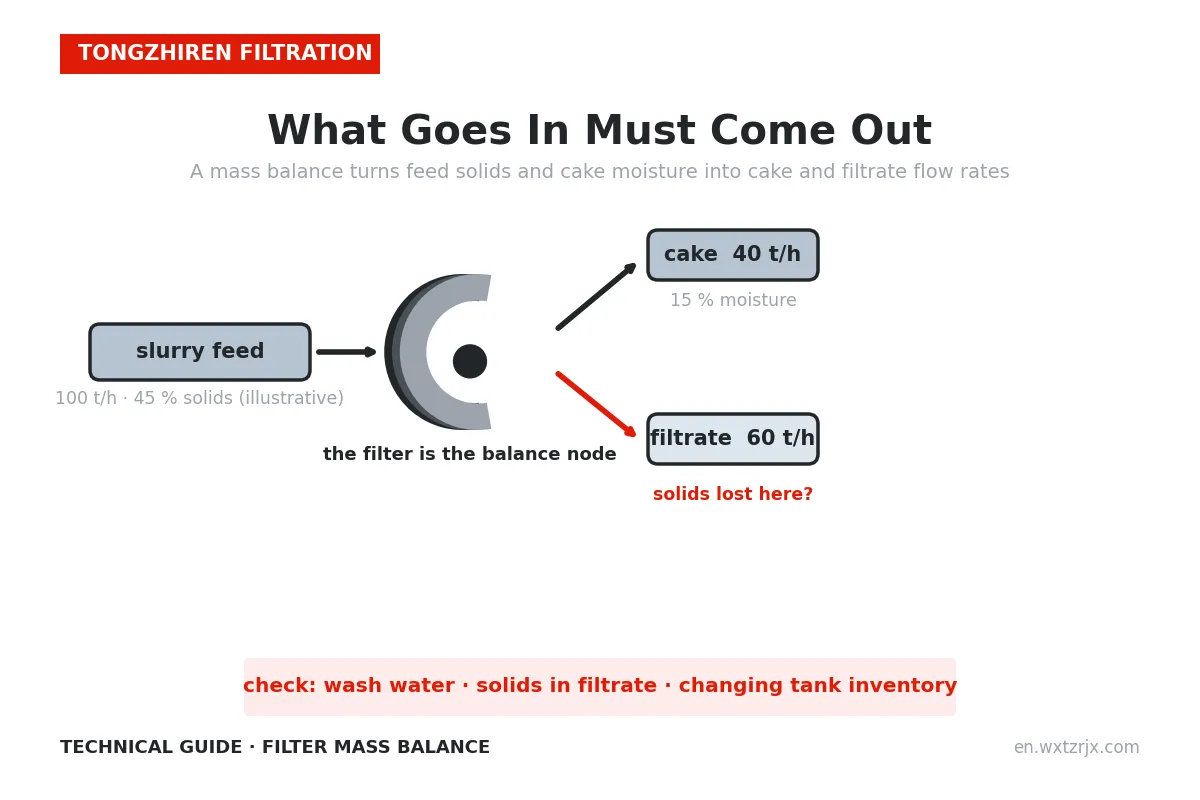
A vacuum filter mass balance accounts for the solids and liquid entering and leaving the filtration system. At steady operation, with negligible solids loss and no added water, wet cake flow equals dry solids flow divided by the cake solids fraction. Filtrate flow is the remaining feed liquid after subtracting the liquid retained in the cake.
This calculation helps check process measurements and estimate average downstream loads. It does not, by itself, establish filter area, peak pump capacity, or equipment performance.
Decide whether the balance covers only the filter or the whole station, including the feed tank, filtrate receiver, and wash system. Water that crosses one boundary may circulate internally within another.
For a simple filter-only calculation, identify:
Use matching time periods for all measurements. A cake sample taken during one feed condition should not be paired with a flow average from another shift.
Let F be feed slurry flow in t/h, x the feed solids mass fraction, and m the cake moisture mass fraction on a wet basis. Write 55% as 0.55 and 12% as 0.12.
For steady operation with all feed solids reporting to cake, no added water, and negligible evaporation:
```text
Dry solids flow, S = F × x
Feed liquid flow, L = F × (1 − x)
Wet cake flow, C = S / (1 − m)
Liquid in cake, W = S × m / (1 − m)
Filtrate liquid flow, Q = L − W
```
All five results are mass flows, not volumetric flows. Convert liquid tonnes per hour to cubic metres per hour using the actual liquid density when necessary.
For this simplified model, liquid is treated as water and the moisture test is assumed to measure that liquid correctly. Brines, volatile components, or dissolved solids may require separate component balances. Check the measurement basis using the guide to wet-basis and dry-basis cake moisture.
Assume a filter receives 100 t/h of slurry at 55% solids by mass and produces cake at 12% wet-basis moisture. These are illustrative inputs, not promised results for a particular filter.
| Stream or component | Calculation | Result |
|---|---|---|
| Feed dry solids | 100 × 0.55 | 55.00 t/h |
| Feed water | 100 × 0.45 | 45.00 t/h |
| Wet cake | 55 / 0.88 | 62.50 t/h |
| Water in cake | 62.50 − 55 | 7.50 t/h |
| Filtrate water | 45 − 7.50 | 37.50 t/h |
The total balance closes: 62.50 t/h of cake plus 37.50 t/h of filtrate equals 100 t/h of feed.
Under these assumptions, the fraction of incoming feed water leaving as filtrate is 37.50 / 45 = 83.3%. That is not automatically the plant's water-reuse percentage. Some filtrate may require treatment or go to a destination outside the reuse circuit.
Suppose 3 t/h of external wash water enters this same boundary. If measured cake output remains 62.50 t/h with unchanged moisture, and all additional water leaves through the filtrate outlet, total filtrate becomes 40.50 t/h.
The extra measured filtrate is not evidence that the filter recovered more original feed water. The outlet now contains water from two inputs. Report total liquid collected and net reuse separately, with clear definitions.
Check whether cloth washing drains into the slurry trough, filtrate system, or a separate sump. Follow the actual piping rather than assuming all wash water reaches one outlet. The distinction between cake washing and cloth washing matters when defining these streams.
When fines pass into the filtrate, cake dry solids are less than feed dry solids. For a measured filtrate suspension flow V in m³/h and suspended-solids concentration c in kg/m³:
```text
Filtrate suspended-solids flow = V × c / 1,000 t/h
```
Subtract that solids flow, and any other solids discharge, from the feed solids before calculating cake flow. If the liquid flow is also unknown, solve the solids and total-mass equations together rather than mixing assumptions from different cases.
A water balance cannot establish whether filtrate is suitable for reuse. That requires separate checks of filtrate solids and water chemistry.
The general relationship is input minus output equals accumulation. Rising feed-tank or receiver levels mean the system is storing material, so a short snapshot may not close as a steady-state balance.
Before changing equipment settings, check timestamp alignment, instrument units, density compensation, cake scale calibration, unmeasured drains, and inventory changes. Do not adjust measured values merely to force closure. Record the residual and compare it with the uncertainty of the measurements.
Use the resulting average flow estimates as inputs to an engineering review. Peak wash demand, startup surges, settling, and operating margins still need separate consideration. For the distinct task of sizing filtration area, see vacuum disc filter capacity calculation.
No. You also need density or an equivalent mass-flow measurement, solids concentration, cake moisture, and the other streams crossing the boundary.
Calculate the change at the actual dry solids rate. Also check whether recovered liquid replaces freshwater or simply changes an internal recycle flow.
It estimates an average duty. Pump selection also needs peak flow, head, liquid properties, suction conditions, and the station operating sequence.
For a project discussion, contact Tongzhiren Filtration with the stream measurements, moisture basis, and boundary drawing. Those details make a filtration inquiry more useful than a slurry-flow figure alone.