
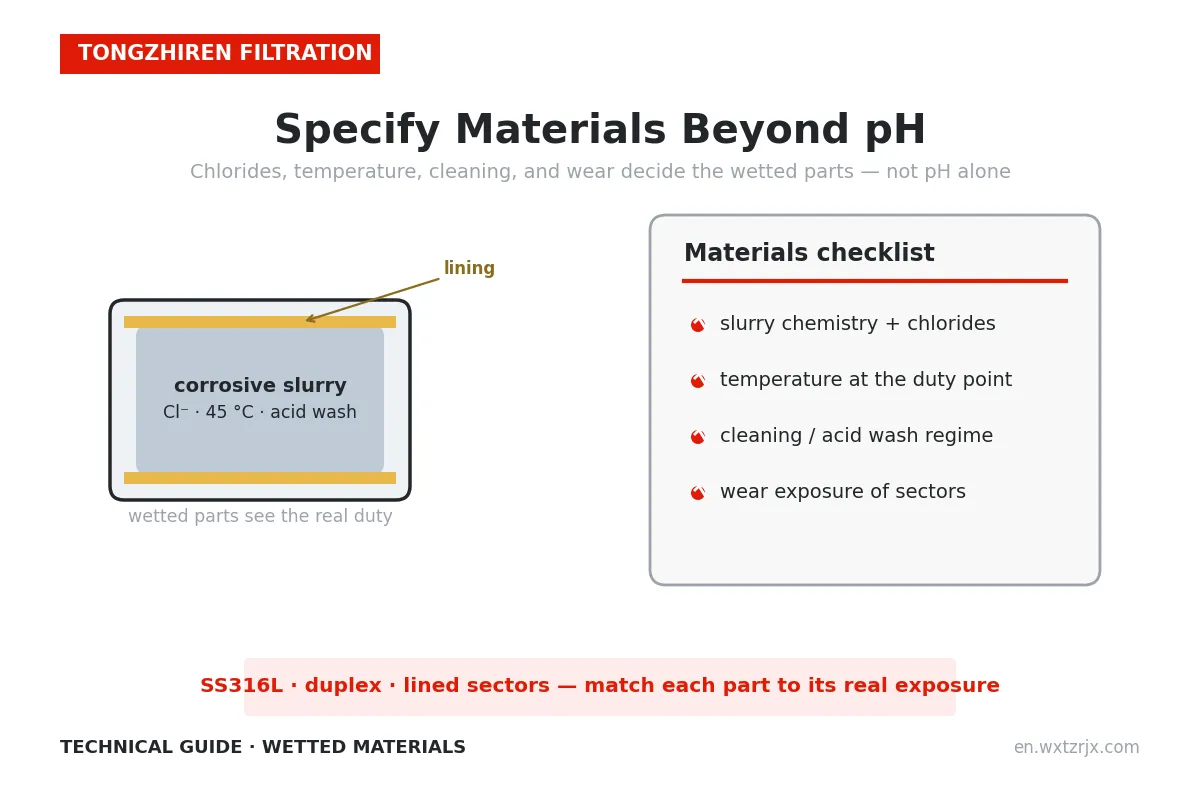
Vacuum disc filter material selection should begin with the actual process liquid, solids, temperature, and cleaning conditions. A statement such as “stainless steel construction” or a single slurry pH value does not define whether the wetted components are suitable for the duty.
The useful purchasing document is a component-by-component materials schedule tied to a stated operating envelope. Final selection requires the equipment supplier and, where necessary, a qualified corrosion specialist to assess the application.
Two slurries with the same pH can expose a filter to different chemical environments. Chlorides, oxidizing chemicals, temperature, deposits, and the condition of the metal surface can affect corrosion behavior.
Outokumpu explains that stainless steels can suffer localized pitting and crevice corrosion in chloride-containing environments. Crevices and deposits can create conditions different from the surrounding bulk liquid. These mechanisms are discussed in its guide to corrosion resistance.
For a filter inquiry, report the measured chemistry and its expected variation. Do not turn a general statement about a stainless steel grade into a blanket promise that it will resist every process stream.
Prepare an exposure sheet that distinguishes normal slurry service from occasional conditions. A cleaning solution or prolonged shutdown may expose parts differently from continuous production.
| Exposure | Information to provide |
|---|---|
| Normal feed | Liquid chemistry, solids content, pH range, temperature range |
| Recycled process water | Relevant dissolved salts, treatment chemicals, seasonal variation |
| Cleaning | Approved chemicals, concentration, temperature, contact time, rinsing procedure |
| Startup and shutdown | Drainage, retained slurry, expected idle time, preservation procedure |
| External environment | Splash, coastal exposure, washdown, indoor or outdoor installation |
Use units and identify the sampling date and location. Mark unknown data as unknown rather than treating missing values as zero.
If the circuit uses recycled water, coordinate this sheet with the plant's process-water quality assessment. The analysis of fresh makeup water may not represent the liquid that actually reaches the filter.
“Stainless steel filter” can leave important scope questions unanswered. Request the proposed material or lining for each relevant component, including the trough, sectors, filtrate passages, piping, valve parts, fasteners, and any supplied receiver.
Separate wetted components from structural parts that are not normally in contact with the slurry. Identify components that see only filtrate, only cleaning liquid, or both.
Ask the supplier to state:
This is an inquiry checklist, not a claim that every construction option is available on every Tongzhiren model. Confirm actual supply capability for the proposed machine.
Chemical compatibility and wear resistance should be reviewed separately. Describe the solids, particle sizes, known abrasive behavior, and locations where the existing equipment loses material.
For replacement projects, provide photographs and maintenance records identifying the affected component and its service interval. Label the observed damage rather than assuming every thin section is corrosion or every pit is abrasion. Inspection may be needed to identify the mechanism.
If a lining is proposed, ask how its compatibility, attachment, inspection, and repair will be addressed. A materials comparison is more useful when it includes maintainability instead of considering only the initial metal grade.
The media, seals, gaskets, hoses, and other nonmetallic parts need their own compatibility review. A suitable metal construction does not automatically make every other component suitable.
Provide the cleaning exposure sheet to the suppliers responsible for these parts. Do not introduce a new cleaning chemical because it appears compatible with the trough alone. Confirm compatibility with the complete wetted assembly and follow the approved cleaning procedure.
For filtration performance considerations specific to the fabric, see the separate guide to filter cloth selection. Cloth selection and mechanical construction should use the same process data, but they are not the same decision.
Published compatibility tables are useful for initial screening, but their test conditions may differ from a mineral slurry. Outokumpu's corrosion-table guidance notes the limitations of laboratory data and recommends representative testing where needed, including consideration of impurities and real service conditions.
Where uncertainty remains, ask a specialist to define an appropriate test. Record which material and surface condition were tested, which liquid was used, and what exposure the result represents. A test of one clean solution should not be reported as approval for every future cleaning chemical or feed composition.
Keep the final decision traceable: process envelope, proposed materials, supporting evidence, outstanding questions, and the responsible approver.
A lower-priced quotation may use a different scope of corrosion-resistant construction. Compare the schedules line by line before deciding that the offers are equivalent.
Include documentation, inspection, replaceable wear components, and limitations alongside the material names. The filter quotation scope checklist helps place this review within the wider equipment purchase.
No universal approval follows from the grade name. Suitability depends on the actual chemistry, temperature, exposure, fabrication, and component geometry. Obtain an application-specific assessment.
Not necessarily. Parts can have different exposure and mechanical requirements. What matters is a documented, technically justified selection for each component.
Send the liquid analysis, operating ranges, solids information, cleaning details, and any damage history. Include the desired documentation and service requirements.
Contact Tongzhiren Filtration with this information to discuss the proposed filtration duty and the materials scope that needs confirmation.