
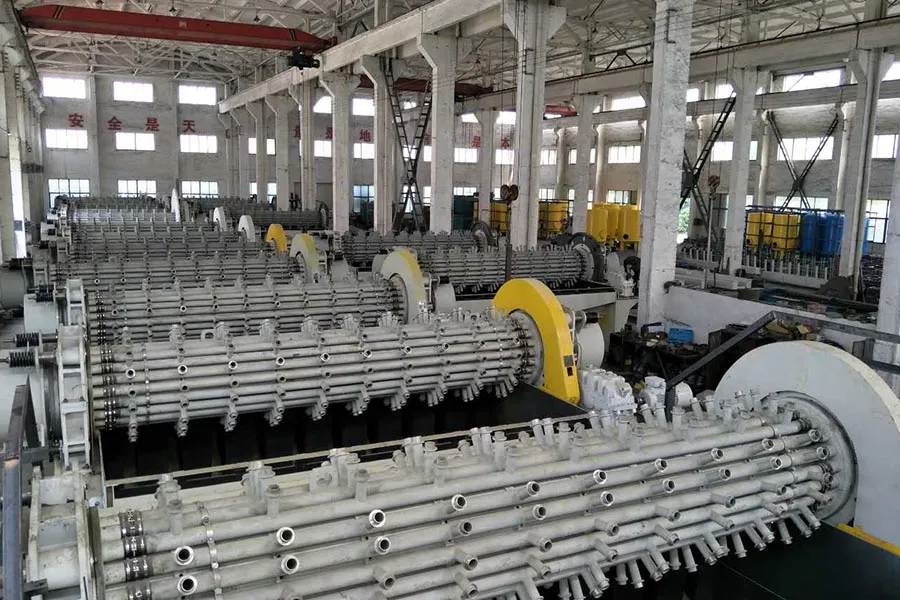
Vacuum disc filters and rotary vacuum drum filters both separate solids from slurry continuously. The main selection differences are how filtration area is arranged, how the cake can be washed, and how it leaves the filter medium. Those differences matter when a plant needs more than a specified number of square metres of filtration area.
A disc filter is often considered when compact continuous dewatering is the priority. A drum filter deserves close evaluation when the duty needs a particular cake-discharge method or a defined washing arrangement. Neither geometry alone guarantees a lower final moisture or a lower total cost.
A conventional vacuum disc filter carries cloth-covered sectors on vertical discs mounted along a shaft. A rotary vacuum drum filter carries the filtration surface around a cylinder. In each design, part of the surface contacts slurry, vacuum draws liquid through the medium, and cake is removed during rotation.
This comparison concerns cloth-based rotary vacuum equipment for industrial slurry. Ceramic disc filters and stacked-disc water filters are different equipment categories. For the former, see the comparison of vacuum disc filters, ceramic filters, and filter presses.
| Selection question | Disc filter considerations | Drum filter considerations |
|---|---|---|
| Is dewatering the main duty? | Evaluate cake formation and discharge across multiple discs | Evaluate the selected drum configuration and cycle |
| Does the product require washing? | Ask for evidence that the proposed arrangement achieves the wash specification | Evaluate the available wash zones and liquid collection arrangement |
| Is the cake difficult to release? | Confirm sector discharge with representative cake | Review the proposed discharge mechanism for the material |
| Is installation space restricted? | Review the complete station and disc-removal access | Review drum dimensions, service access, and discharge equipment |
| Is the feed variable? | Test difficult feeds as well as normal slurry | Use the same feed envelope for a fair comparison |
Use this table to organize supplier questions. It is not a substitute for testing the actual slurry.
A filter must repeatedly release its cake to maintain usable area. Throughput measured during cake formation is incomplete evidence if the solids then remain attached to the medium.
Disc configurations commonly use blowback-assisted discharge. Drum filters can use different arrangements depending on the material. For example, ANDRITZ describes scraper, roller, string, belt, and other options in its TSF drum-filter documentation. These options apply to the relevant engineered configuration, not automatically to every drum filter.
During testing, document whether cake releases fully, fragments into the intended chute, sticks at the transfer, or leaves uneven residue. Include repeated cycles and the expected range of cake thicknesses.
For a sticky product, ask suppliers to explain the discharge mechanism they propose and the evidence supporting it. Choosing from a general brochure photograph leaves a critical operating question unanswered.
Cake washing removes or displaces liquid held in the solids, often to reduce a dissolved impurity or recover process liquor. Specify the residual impurity or recovery target, the permitted wash-liquid quantity, and the required cake condition after washing.
The presence of spray nozzles does not prove that a filter can meet a product-washing requirement. A spray system may be intended to clean exposed cloth after discharge.
Ask how wash liquid reaches the cake, how uniformly it passes through it, and whether the resulting filtrate can be collected as required. If separate wash fractions are important to the process, include that in the test and equipment specification.
For a difficult wash duty, a drum configuration may be worth evaluating alongside other suitable technologies. Confirm the complete arrangement through testwork rather than assigning washing performance from the machine name alone.
Multiple discs can provide substantial filtration area within a compact machine. ANDRITZ's STARDISC product description explains how disc size and number are used to configure area.
For the plant decision, include the vacuum system, receivers, pumps, platforms, chutes, and component-removal paths. A smaller equipment outline may still require a larger building arrangement if auxiliaries and service access are placed differently.
Request a layout showing operating and maintenance space for both options. The filter station layout guide provides the questions to use during that review.
Provide both suppliers with equivalent representative slurry and one agreed product specification. Record feed concentration, particle-size distribution, chemistry, temperature, and expected variability.
Compare these results together:
dry-solids production at the required cake moisture;
cake discharge over repeated cycles;
filtrate solids and any associated product loss;
residual impurity and wash-liquid use when washing is required;
utility demand and the assumptions used for scale-up;
cleaning requirements and sensitivity to feed changes.
Do not combine the highest throughput from one test with the lowest moisture from another and present them as a single operating point. Identify which requirements were achieved simultaneously.
The slurry sampling guide helps prepare material for a useful comparison. Actual throughput and moisture commitments should remain tied to the tested feed conditions.
Consider a hypothetical concentrate that forms a stable cake, releases reliably, and needs no dedicated product wash. The plant's main constraint is available station space. A disc filter would be a reasonable candidate to investigate, with station layout and utilities included in the comparison.
Now consider a hypothetical product whose specification limits dissolved contamination and whose cake is difficult to release. The selection should first establish a workable wash and discharge arrangement. A drum configuration may warrant testing even if its nominal area or machine dimensions differ from the first option.
These examples illustrate the decision sequence. They are not installation results or claims that one design wins every duty in either category.
Check whether the proposal includes vacuum equipment, filtrate handling, wash systems, controls, and discharge interfaces. Also identify whose scope covers supports, conveyors, and plant integration.
Compare the cost of meeting the same product specification at the required production, including any downstream consequences. A low equipment price has limited meaning if another package includes essential auxiliaries that must otherwise be purchased separately.
Use the supplier scope checklist to place proposals on a common basis.
For an initial selection discussion, prepare the dry-solids rate, feed analysis, particle-size distribution, moisture target, washing requirement, cake-handling destination, and layout constraints.
Contact Tongzhiren Filtration with these details and available test results. Ask which disc or drum configuration should be evaluated and what further testing is needed before confirming the selection.
No universal result follows from the name. Assess the proposed washing arrangement against a measured product specification and wash-liquid limit.
Its area arrangement can be compact, but the comparison must include auxiliaries, access, and cake handling for the complete station.
Yes. Equivalent representative feed and common acceptance criteria make the results easier to compare. Each test must reproduce the relevant operating sequence.
That depends on the material, cake thickness, available pressure differential, cycle conditions, and required throughput. Compare simultaneous test results rather than catalogue maxima.