
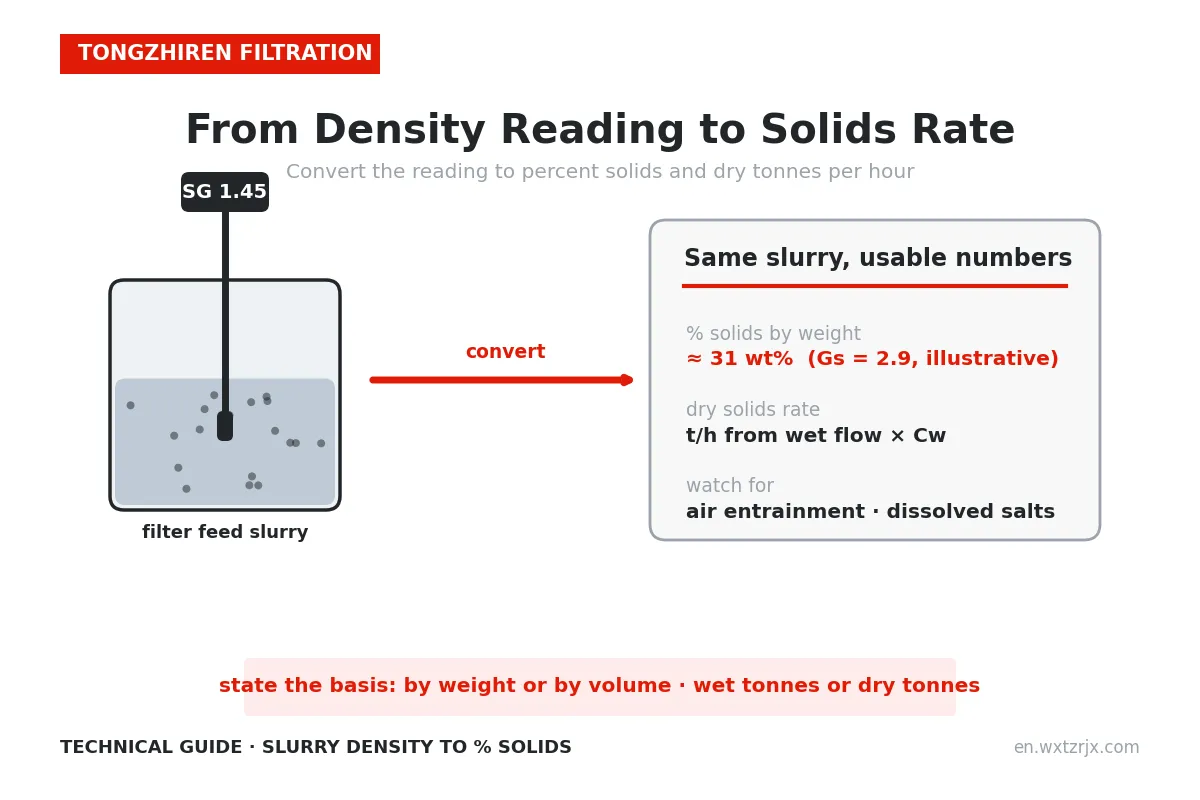
Slurry density can be converted to solids concentration when the densities of the solid particles and the liquid are known. The calculation also requires a suitable model of the mixture: suspended solids and liquid, with negligible entrained gas and approximately additive volumes.
A density reading alone cannot establish percent solids for every mineral slurry. A change in mineral composition, liquid chemistry, or air content can change the relationship. For vacuum disc filter selection, report the assumptions alongside the calculated concentration.
For a two-phase slurry, the solids mass fraction is:
w = ρs × (ρm − ρl) / [ρm × (ρs − ρl)]
Where:
w is the solids mass fraction; multiply by 100 for weight percent.ρm is slurry density.ρs is the density of the solid particles.ρl is liquid density.All densities must use the same units. The solid-particle density is not the loose bulk density of a dry powder pile, which includes spaces between particles.
The equation follows from adding the masses and volumes of the two phases. For a unit mass of slurry, 1/ρm = w/ρs + (1−w)/ρl. Rearranging gives the formula above.
Assume the measured slurry density is 1.60 t/m³, the particle density is 3.20 t/m³, and the liquid density is 1.00 t/m³.
w = 3.20 × (1.60 − 1.00) / [1.60 × (3.20 − 1.00)]
w = 1.92 / 3.52 = 0.54545
The slurry therefore contains approximately 54.55% solids by weight under these assumptions.
This is an illustrative calculation, not a recommended filter-feed concentration. The appropriate operating range depends on filtration testing, slurry handling, and the selected equipment.
Weir's technical paper on viscous thickener underflow presents a concentration matrix using separate solids, liquid, and slurry densities. That distinction is important when interpreting a plant density signal.
Solids by weight describes the solid mass divided by total slurry mass. Solids by volume describes particle volume divided by total slurry volume.
Under the same two-phase assumptions:
Solids volume fraction = (ρm − ρl) / (ρs − ρl)
For the example above:
(1.60 − 1.00) / (3.20 − 1.00) = 0.27273
The slurry is approximately 27.27% solids by volume, despite being 54.55% solids by weight. These values describe the same mixture.
Always label the reporting basis. A specification that says only “55% solids” leaves an avoidable ambiguity for the filter supplier and the plant team.
Consider two illustrative slurries with the same measured density of 1.60 t/m³ and liquid density of 1.00 t/m³:
| Assumed particle density | Calculated solids by weight |
|---|---|
| 3.20 t/m³ | 54.55% |
| 4.00 t/m³ | 50.00% |
The density instrument could display the same number while the actual solids concentration differs. If the mineral blend changes, a conversion configured with one fixed particle density may need review.
Use representative particle-density information for the mixture. Do not substitute the density of pure valuable mineral when the feed also contains other minerals. Likewise, a simple arithmetic average of component densities is not necessarily the correct mixture value; the component proportions and basis matter.
When density is expressed in tonnes per cubic metre:
Dry-solids rate (t/h) = Slurry flow (m³/h) × Slurry density (t/m³) × w
For 30 m³/h of the example slurry:
30 × 1.60 × 0.54545 ≈ 26.18 dry t/h
The total slurry mass rate is 48 t/h, but the dry-solids rate is only about 26.18 t/h. Using total slurry mass as dry-solids production would substantially overstate the filtration duty.
The filter capacity calculation guide explains how dry-solids throughput relates to tested filtration area. Keep the density and flow measurements aligned in time when using them for a production calculation.
Gas introduces another phase. A density measurement affected by air should not automatically be interpreted through a solids-and-liquid-only equation. Review the measurement method, installation, and sample condition with the instrument supplier.
Process liquor may have a density different from water. Use the relevant liquid density rather than assuming 1.00 t/m³. Also distinguish suspended solids from dissolved material that remains after evaporation.
Density values should represent appropriate temperature conditions. If a laboratory value and plant signal refer to different conditions, document how that difference is handled.
A sample that segregates before measurement may not represent the flowing stream. Preserve a representative mixture and use the agreed measurement procedure.
These limitations do not make density measurement unhelpful. They define what must be known before treating a converted percentage as reliable.
Compare calculated concentration with an appropriate laboratory determination across the expected operating range. Use matched samples and record density, temperature, composition information, and the analytical method.
For liquor containing substantial dissolved material, agree how the laboratory distinguishes suspended particles from dissolved residue. Otherwise, a drying result and a density-based suspended-solids calculation may measure different quantities.
If the comparison changes with ore blend or process-water conditions, investigate the conversion assumptions before changing the filter's operating target.
The thickener underflow guide addresses feed stability. Density conversion answers a narrower question: what solids concentration the measured value represents.
Send volumetric flow, measured slurry density, particle-density basis, liquid density, solids percentage with its basis, and the expected range of each value. Identify which numbers are measured and which are calculated.
Include representative slurry for testing and explain changes in mineralogy or process liquor. Contact Tongzhiren Filtration with these data to discuss the dry-solids duty and filtration assessment.
Not uniquely. The calculation also needs particle and liquid densities and a valid mixture model.
No. Bulk density includes spaces between particles. The conversion uses the density of the particles themselves.
Only when that assumption represents the process sufficiently well. Brines and other process liquors may require their own measured density.
For unchanged phases under the model, yes. Across different mineral or liquid compositions, the same inference may be misleading.