
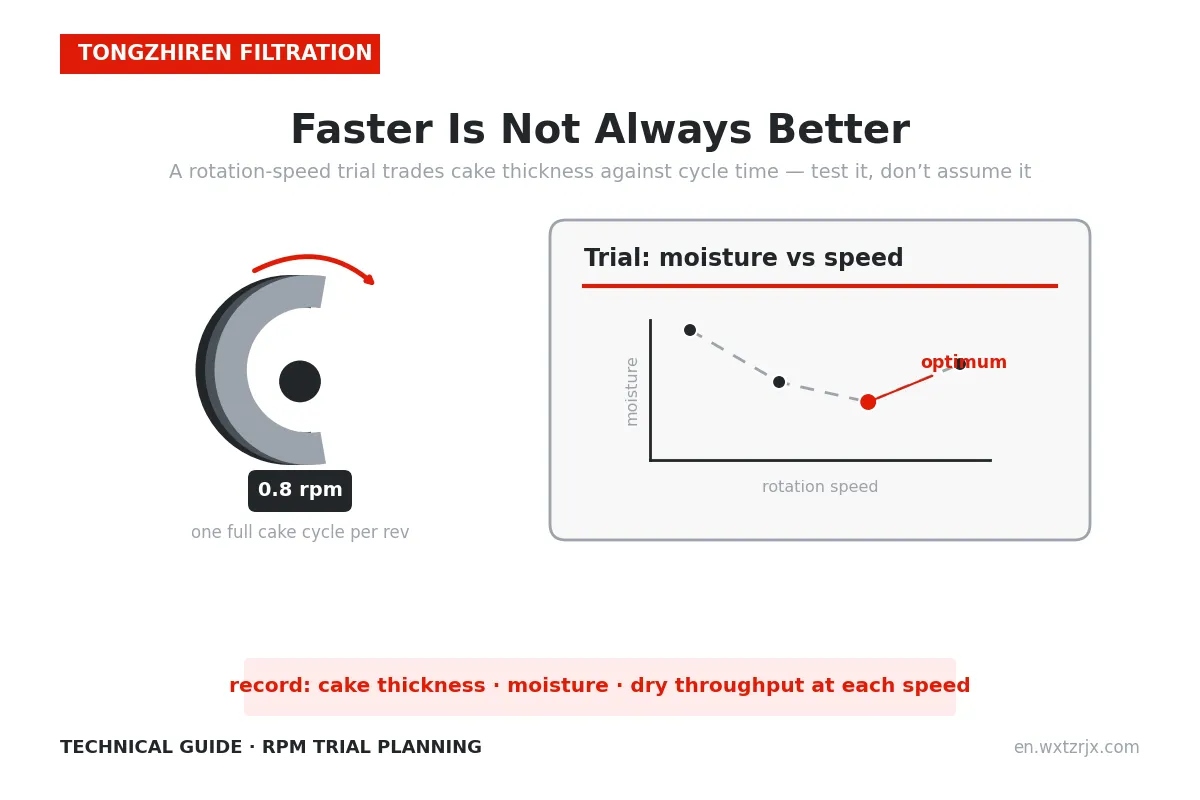
Vacuum disc filter rotation speed controls how often each sector completes its cycle and how long it spends in each operating zone. Increasing speed shortens both cake formation and drying time when zone angles remain fixed. The best setting is the one that delivers the required dry throughput and moisture with reliable discharge—not simply the highest available RPM.
There is no universal speed setting for every mineral slurry. Any trial must stay within the equipment manufacturer's approved operating range and the site's operating procedure.
A sector passes through slurry, emerges with cake, continues dewatering, and reaches discharge. ANDRITZ describes this sequence in its vacuum disc filter operating principle. Its published equipment ranges describe its own products, not settings to transfer to a different machine.
Faster rotation gives more revolutions per hour but less time per revolution. It may produce a thinner cake, yet also allow less time for liquid removal. A slower setting can give more drying time while producing a thicker cake that is harder to dewater. The combined result needs measurement.
Metso's concentrate filtration guide explains that dewatering depends on the cake pore structure and pressure difference, and that reduced cake thickness can help when moisture is excessive. Longer time alone therefore does not explain every moisture result.
For a speed n in revolutions per minute:
```text
Seconds per revolution = 60 / n
Seconds in a zone = (zone angle / 360) × (60 / n)
```
Suppose, purely for illustration, a machine has an effective cake-formation zone of 120 degrees and an effective drying zone of 150 degrees.
| Speed | Revolution time | Formation time, 120° | Drying time, 150° |
|---|---|---|---|
| 1.0 rpm | 60 s | 20 s | 25 s |
| 1.5 rpm | 40 s | 13.3 s | 16.7 s |
This table illustrates timing, not recommended operating speeds or zone angles. Confirm effective zones from the actual machine drawings, slurry level, and control arrangement. Time above the slurry is not necessarily all active vacuum drying time.
Also distinguish RPM from revolutions per hour: 60 revolutions per hour equals 1 RPM. Record the unit beside every speed value.
A useful speed trial compares similar feed conditions. Record feed solids, flow, particle-size information where available, temperature, trough level, vacuum at a consistent measurement point, and cloth condition.
Take baseline cake and filtrate samples using the site's approved sampling arrangements. Keep hands, tools, and measuring devices away from moving discs; do not take manual thickness measurements on rotating equipment. Use safe observation methods and isolate equipment for physical inspection.
If feed conditions are drifting, first investigate thickener underflow stability. Otherwise, a change in feed may be mistaken for a benefit or penalty caused by speed.
A wet cake conveyor can look busier because it carries more water. At each trial point, calculate dry output from matched wet cake flow and wet-basis moisture measurements.
For example, an illustrative baseline of 20 t/h wet cake at 10% moisture gives 18 t/h dry solids. A second setting producing 21 t/h wet cake at 15% moisture gives 17.85 t/h dry solids. Wet output increased, but dry production did not.
That comparison does not establish which setting a real plant should use; it shows why moisture and output must be measured together. Confirm the cake moisture basis before comparing results.
Agree on modest changes within the approved range. Keep other adjustable settings unchanged where practicable, and document any unavoidable changes. Wait for the filter and measurement system to stabilize before sampling; use the process response rather than a universal waiting time.
For each setting, record:
Where practical, return to the baseline setting. If the original performance does not return, feed changes or equipment drift may have affected the comparison. Do not present a single short run as a guaranteed operating improvement.
Reject a setting that misses the agreed moisture requirement or creates unstable discharge, even if it briefly increases throughput. Among acceptable settings, compare sustained dry output and the consequences for downstream handling.
The outcome may be an operating window for a defined feed range rather than one permanent RPM. If no approved setting achieves the required result, review testwork and the full filtration duty instead of exceeding machine limits.
This speed trial is an operating adjustment exercise, not a replacement for filter capacity and area sizing.
No. Slower rotation increases time per cycle but can also increase cake thickness. Measure the combined effect on moisture and dry output.
It should not be used to conceal a mechanical or media defect. Address the defect through the approved maintenance procedure before interpreting a speed trial.
Provide the machine identification, approved speed range, current RPM, feed data, zone information, and a matched moisture-throughput trial record.
Contact Tongzhiren Filtration with those details when discussing an existing filtration duty or a new equipment inquiry.